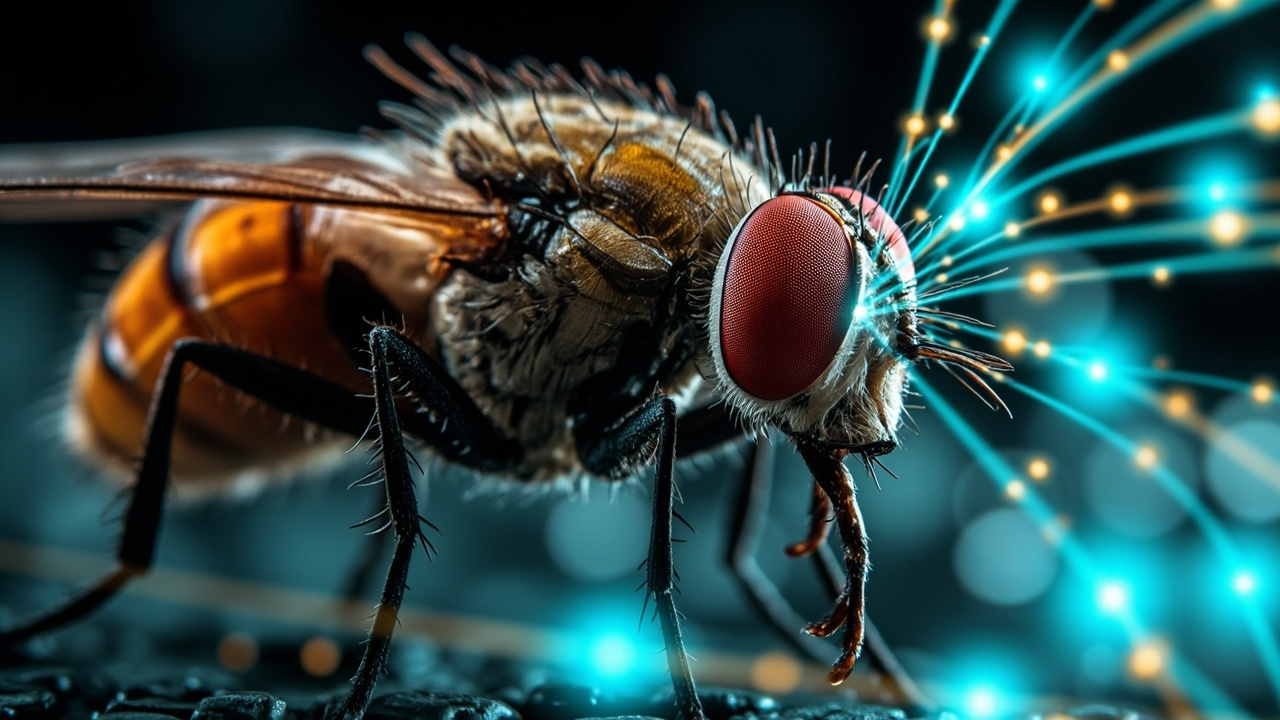
TL;DR: Researchers Kevin Max and Yang Shen at the Okinawa Institute of Science and Technology built Spi-Fly, a scent-classification algorithm that copies sparse coding from the fruit-fly brain to learn odors in three exposures and retain old odors while adding new ones.
Fruit-fly brain inspires an electronic nose that keeps old memories
Researchers at the Okinawa Institute of Science and Technology described a new odor-classification algorithm called Spi-Fly in the journal Neuromorphic Computing and Engineering, according to Ars Technica. The paper lists Kevin Max and Yang Shen as authors. The report by Ars Technica was published Sept. 3, 2026, by Federica Sgorbissa. The work was also summarized Aug. 30, 2026, by La Vanguardia. The algorithm copies part of the olfactory system of Drosophila to classify sensor signals with few examples and to add new categories without erasing earlier ones.
The study used simulation with pre-recorded sensor data, according to Ars Technica. Spi-Fly did not capture smells directly. A separate sensor had already recorded the signals. The algorithm started after that recording step and converted those readings into spikes for classification.
According to Ars Technica, tests with common gas sensors showed Spi-Fly reached peak accuracy after just three exposures to each odor. A comparison network trained with backpropagation needed roughly 70 exposures to reach the same level. When new odors were introduced a couple at a time, Spi-Fly held onto old smells with almost no accuracy loss, while the backpropagation baseline fell to near random-guessing territory. La Vanguardia reported tests on two experimental odor databases with the same pattern: strong performance with few examples and continued recognition of earlier odors after new ones were added.
Why smell is unusually hard for computers
Vision and hearing can be plotted along wavelength, which makes them relatively tidy to study, according to Ars Technica. Odor molecules cannot be reduced to any single physical dimension. Biology instead uses hundreds of different receptor proteins, each shaped to grab onto specific molecular features. Those receptors fire in combinations that the brain must decode.
That combinatorial system remained unmapped for decades. Linda Buck and Richard Axel identified the receptor gene family behind it in 1991, according to Ars Technica. That work received the Nobel Prize in 2004. The delay shows how complex the biological starting point is for any machine version.
La Vanguardia described the same constraint in engineering terms. More complex tasks usually demand more data and more processing capacity. That demand becomes a problem for devices with little memory, limited energy resources, or information that arrives progressively over time. Smell classification fits that difficult category because every new chemical mixture can change the signal.
Where electronic noses are used today
Electronic noses are already sold commercially, according to Ars Technica. Companies named in that reporting include Alpha MOS, Aryballe, and Odotech. Reported uses include food-quality control, environmental monitoring, and security screening.
A device tuned to sniff out spoiled olive oil is not the same as a device that flags a specific explosive at an airport checkpoint, according to Ars Technica. Retooling one device for a new task usually means retraining its software almost from scratch. That lack of generalization keeps costs high and keeps each deployment narrow.
OIST researchers listed additional potential uses for scent classification, according to a Sept. 2, 2026, post from the Okinawa Institute of Science and Technology. Those uses included detecting explosives, assessing allergen levels, ensuring food safety, and identifying drugs. Max said theoretically Spi-Fly could work on any classification problems beyond just odors. He described brain-inspired, hardware-compatible algorithms as a route to many applications.
Two bottlenecks: labeled data and catastrophic forgetting
According to Ars Technica, current systems typically need a mountain of hand-labeled examples before they can reliably tell one smell from another. Collecting and labeling those examples is slow and expensive. A system that needs dozens of exposures per odor is difficult to deploy where samples are scarce.
The second bottleneck is catastrophic forgetting. Teaching a conventional system a new odor tends to scramble what it already knew, according to Ars Technica. New training overwrites old connections. La Vanguardia described the same failure: when conventional systems receive new information and train again, they can lose part of what was learned earlier.
Spanish-language coverage in El Ecosistema Startup, published Sept. 3, 2026, framed those two points as few-shot learning and continual learning. Few-shot learning means classifying correctly after only a few examples. Continual learning means still recognizing old categories after learning new ones. Spi-Fly was designed to handle both, according to that summary of the paper identified as DOI 10.1088/2634-4386/ae9177.
What the fly does with 140,000 neurons
The fruit-fly brain contains roughly 140,000 neurons in a package smaller than a poppy seed, according to Ars Technica and the Okinawa Institute of Science and Technology. Drosophila can sort through a wide range of smells in a fraction of a second and retain the memory of that scent for a long time, according to Ars Technica.
Yang Shen, co-author and OIST researcher, said the fly brain is one of the best-mapped brains, simple enough to study as a whole while still performing complex processing, according to La Vanguardia. A Sept. 2, 2026, science post noted that a complete connectome of only 140,000 neurons was revealed in 2024. That mapped circuit makes the fly a practical model for whole-system imitation.
The secret highlighted by Max and Shen is sparse coding, according to Ars Technica. Sparse coding represents each odor with lower energy cost by activating only a small fraction of neurons. La Vanguardia described inhibition as the mechanism that reduces the number of active neurons, leaving each odor associated with a sharply differentiated representation.
Kenyon cells, APL neurons and odor barcodes
The fly olfactory system relies on roughly 2,000 specialized cells called Kenyon cells, according to Ars Technica. Those cells receive sparse, randomly wired signals passed on from odor receptors. The Kenyon cells report to the anterior paired lateral neuron, or APL, actually a symmetrical pair with one per brain hemisphere.
The APLs fire strong, global inhibition back at every Kenyon cell at once, silencing nearly all of them, according to Ars Technica. The cells that remain active after that inhibition form what Max and Shen call the barcode for that particular odor. La Vanguardia compared the result to a neural identification tag, with only a small part of the intermediate population active for each smell.
Because different signals produce sufficiently separated patterns, the system can distinguish them without costly training, according to La Vanguardia. Information arrives, it is transformed into a specific representation, and an output stage learns to associate that pattern with the corresponding odor.
Inside Spi-Fly: three layers and mutual inhibition
Spi-Fly translates that biological principle into a three-layer computing architecture, according to La Vanguardia. Input signals are distributed randomly and sparsely toward an intermediate layer. That hidden layer contained 1,000 neurons in the implementation described by La Vanguardia and Наука Mail. Only a small fraction activates for each odor.
In Max and Shen's work described by Ars Technica, sensor readings become a stream of spikes. Those spikes are projected sparsely and randomly onto a hidden layer that stands in for the Kenyon cells. Neurons inhibit each other instead of relying on a single APL-like referee. The hidden layer then connects to an output layer with one neuron per labeled odor. That output layer waits to learn which barcode belongs to which smell.
The design separates sensing from interpretation. Everything reported here happened in simulation using pre-recorded sensor data, according to Ars Technica. The algorithm itself had nothing to do with capturing the smell in the first place. That separation matters because physical sensors and classification software can be improved independently.
A decades-old learning rule replaces backpropagation
What actually gets learned is the connection between a barcode and its label, according to Ars Technica. The update follows a simple, decades-old neural network rule: every time a hidden neuron fires alongside the correct answer, that link gets a little stronger. Nothing more is required in that step.
There is no need for backpropagation in Spi-Fly, according to Ars Technica. Backpropagation was co-invented by 2024 physics Nobel laureate Geoffrey Hinton. It trains most modern neural networks by working backward through every layer to calculate responsibility for a mistake. Spi-Fly avoids that backward pass entirely.
La Vanguardia described the final stage in similar terms. After transformation into a specific representation, an output layer learns to associate that pattern with the corresponding odor. El Ecosistema Startup described it as associative learning from a sparse projection. The approach keeps computation local and avoids repeated large-scale retraining.
Three exposures versus seventy
On a set of odors picked up by common gas sensors, Spi-Fly peaked after just three exposures to each one, according to Ars Technica. Backpropagation needed roughly 70 exposures to get there. That gap is central to the reported result because labeled odor data are costly to collect.
La Vanguardia reported the same advantage using two experimental odor databases and comparison against other classification methods. According to co-author Kevin Max, the algorithm could classify odors correctly after receiving only a few samples. Наука Mail, citing Газета.Ру on Aug. 29, 2026, reported that the system needed only several samples to learn to distinguish smells and that it showed high accuracy in those tests.
The result does not mean Spi-Fly beats every traditional method on every task. El Ecosistema Startup noted that the paper and Ars Technica reporting indicate Spi-Fly does not exceed the best traditional machine-learning algorithms in all situations. The demonstrated edge is in learning from few examples and retaining earlier categories, not in every overall accuracy comparison.
Holding old scents while adding new ones
Researchers fed the network new odors a couple at a time as a stress test for catastrophic forgetting, according to Ars Technica. Spi-Fly barely changed, holding onto old smells with almost no accuracy loss. Backpropagation crashed into near random-guessing territory under the same incremental procedure.
La Vanguardia reported that Spi-Fly incorporated new odors without deleting knowledge acquired about earlier ones. That capability supports systems that must adapt continuously to changing environments. Наука Mail also reported continuous learning: adding new smells without forgetting already studied ones, a problem known as catastrophic forgetting in many standard machine-learning methods.
That behavior follows from separated barcodes. When each odor uses a distinct small subset of hidden neurons, learning a new association touches different connections than those storing old associations, according to the sparse-coding explanation summarized by Ars Technica and La Vanguardia. The overlap between representations stays low, so interference stays low.
Built for neuromorphic chips with little memory
Another practical hurdle is memory, according to Ars Technica. The network was kept simple to eventually run on neuromorphic chips. Those chips mimic the brain directly by processing spikes instead of running conventional software. They typically do not have much memory. Any algorithm running on one must make do with a fraction of what a regular computer takes for granted.
Spi-Fly degraded far less than backpropagation under those constraints, according to Ars Technica. The finding matters for edge hardware, low-power sensing, and Internet-of-Things devices where energy and memory are limited. La Vanguardia framed the same point as progressive learning with lower resource consumption instead of dependence on very large training processes.
Max said hardware-compatible, brain-inspired algorithms could support many uses, according to the Okinawa Institute of Science and Technology. The statement covered scent classification and, theoretically, any classification problems beyond odors. The emphasis on hardware compatibility points directly to neuromorphic deployment rather than data-center GPUs.
Capacity ceiling: 75 million codes, a few hundred usable odors
There is a ceiling, as Max himself acknowledged, according to Ars Technica. The theoretical limit follows combinatorics. If the sparse-code layer contains 100 neurons and each odor is represented by 5 neurons, the upper limit is 100 choose 5, roughly 75 million possible barcodes.
Real-world noise erases nearly all of that headroom, according to Max in comments summarized by Ars Technica and mirror coverage. The same odor is almost never represented by the same sparse code in two exposures because of noise, airflow conditions, and related variation. Given the parameters of the model, it should be able to represent a couple hundred odors, depending on odor types and similarities between them.
El Ecosistema Startup added two related limits. Spi-Fly had not yet been proven on complex odor mixtures critical for real settings such as a food factory or an airport. The algorithm also needs a physical sensor to capture odors; by itself it detects nothing. Those constraints define what remains before commercial use.
Toward an artificial nose
The stated goal is to build a kind of artificial nose by combining substance-detecting sensors with signal-interpreting software, according to La Vanguardia. Researchers are now working on sensors that would allow integration of the algorithm into that future device. Such technology could find applications where rapid automated odor identification is needed, although Spi-Fly still must be checked outside the experimental setting.
Наука Mail reported that Spi-Fly is planned to be combined with odor-recognition hardware systems developed by researchers at Kiel University in Germany. El Ecosistema Startup also pointed to OIST collaboration with groups at TU Eindhoven and the University of Kiel on olfactory sensing hardware where Spi-Fly could be integrated. The common element across those summaries is pairing the classifier with physical sensing hardware for a complete low-power artificial nose.
According to Ars Technica, that pairing is still ahead. The published tests used pre-recorded data in simulation. Physical integration, mixture testing, and validation under factory or field airflow remain future steps, not completed outcomes in the Sept. 3, 2026, reporting window.
Why this matters for U.S. science and technology
For U.S. laboratories, food producers, environmental monitors, and securityCheckpoint operators, the appeal is a classifier that learns from few labeled samples and does not require retraining from scratch for each new target, according to the uses and limits described by Ars Technica and OIST. A device tuned for spoiled olive oil and a device screening for a specific explosive currently diverge early and require separate retraining. A shared sparse-coding front end could reduce that retooling cost.
The result also speaks to neuromorphic computing, a fast-developing hardware path in the United States and Japan that processes spikes directly, according to Ars Technica. Algorithms that tolerate tight memory budgets are prerequisites for that hardware. Spi-Fly was explicitly designed with that constraint in view and degraded less than backpropagation when memory was restricted.
The paper appeared in Neuromorphic Computing and Engineering under DOI 10.1088/2634-4386/ae9177, according to El Ecosistema Startup and laboratory posts. The Sept. 3, 2026, Ars Technica account provides the detailed performance comparison of three versus roughly 70 exposures and the incremental-learning test. The Aug. 30, 2026, La Vanguardia account provides the three-layer, 1,000-neuron implementation detail and the two-database test scope. Together they describe a completed simulation study with a defined next step: connect Spi-Fly to real-time olfactory sensors and test mixtures outside the lab.
Sources referenced
- Just like a fruit fly, a new algorithm never forgets old scents - Ars Technica (https://arstechnica.com/science/2026/09/just-like-a-fruit-fly-a-new-algorithm-never-forgets-old-scents/)
- ¿El futuro de la IA? Un algoritmo inspirado en moscas logra identificar olores con energía mínima - La Vanguardia (https://www.lavanguardia.com/clic/20260830/11623156/futuro-ia-algoritmo-inspirado-moscas-logra-identificar-olores-energia-minima-epm.html)