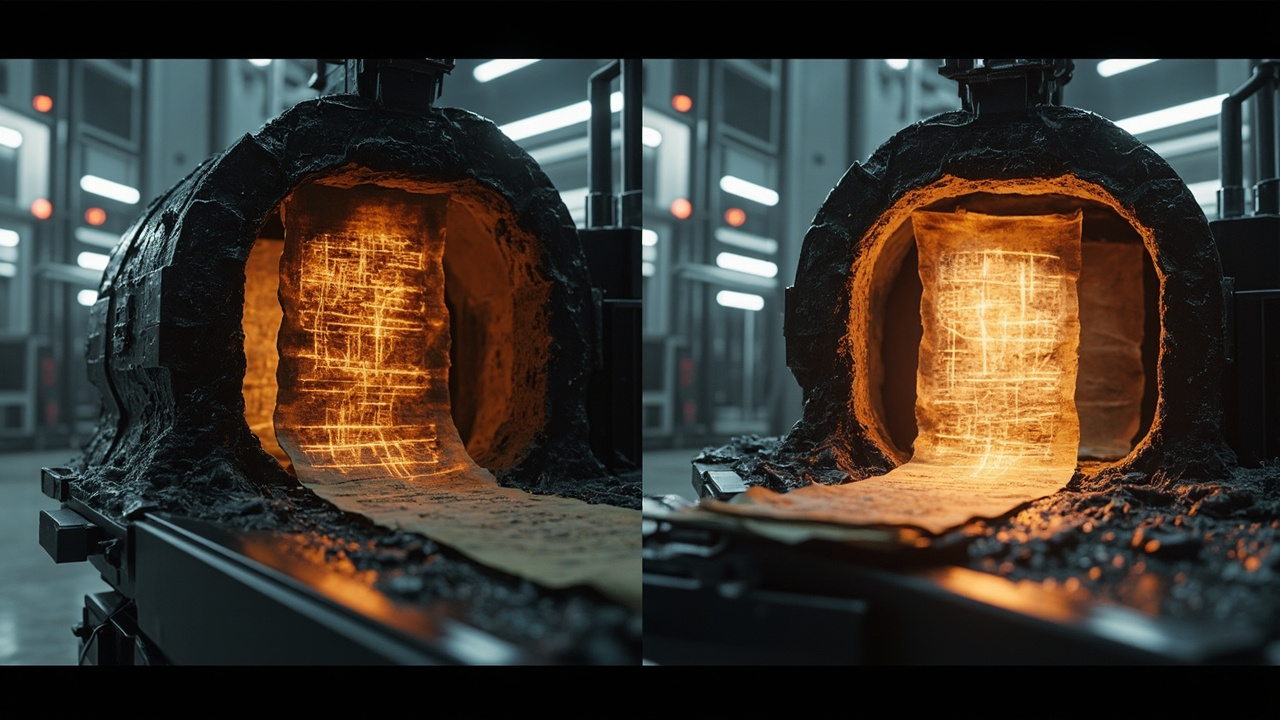
TL;DR: Scientists built and burned their own papyrus scrolls to prove that lead in ink makes charred Herculaneum texts readable by X-ray tomography and detectable with a handheld scanner.
A team led by retired inventor Douglas Seiler fabricated a contemporary scroll from modern Egyptian papyrus, wrote on it with lead-treated ink, carbonized it in a furnace, and then read the hidden writing with laboratory X-ray tomography without opening it. The result, reported September 16, 2026, in the journal PLOS ONE, provides the first controlled proof that lead dramatically improves X-ray contrast for carbonized scrolls and points to a practical way to pick the most promising ancient rolls for detailed scanning.
Why burned Roman books resist reading
The Herculaneum papyri comprise several hundred ancient manuscripts found in 1752 CE at the Villa of the Papyri in Herculaneum near Naples, Italy, beside Pompeii, according to the PLOS ONE paper. The villa, likely owned by a member of the Piso family, was uncovered during excavations sponsored by the Bourbon kings of Naples. The collection had been buried beneath volcanic ash and rock since the catastrophic eruption of Mount Vesuvius in 79 CE, which left the rolls carbonized, essentially converted to brittle charcoal, yet preserved in shape.
That survival makes the group the only known intact library from classical antiquity, the PLOS ONE authors wrote. Most texts recovered so far contain philosophical treatises, largely from the Epicurean school. The majority were authored by Philodemus of Gadara, dated ca. 110 BCE to ca. 40 BCE, while important works by Epicurus himself and other Epicureans have been identified.
A few Stoic texts, apparently all by Chrysippus, and Latin texts have also been found, including an epic poem on the Battle of Actium and the recently identified Histories of Seneca the Elder, according to the PLOS ONE study. The significance, the authors explained, lies both in new light on ancient philosophy and its opponents, and in the fact that every text is new to modern readers. None arrived through the usual path of monastic copying through Late Antiquity and the Middle Ages.
According to Berkeley News, the eruption that carbonized the library also buried nearby Pompeii, preserving for posterity that singular ancient collection. Berkeley News reported that more than a thousand papyrus rolls were in a library inundated in 79 C.E., turning ancient learning into brittle, carbonized husks. The same report noted that what remains of the library's estimated 1,800 scrolls and scroll fragments is now housed in Italy, France and England.
Ars Technica described the broader setting as an ancient Roman resort region destroyed in the catastrophic 79 AD eruption, with Herculaneum struck by clouds of hot gas called pyroclastic pulses and flows. One palatial residence believed to have belonged to a man named Piso held hundreds of papyrus scrolls singed into carbon by volcanic gas, according to Ars Technica. The rolls remained buried under volcanic mud until excavation in the 1700s from a single room thought to hold the personal working library of an Epicurean philosopher named Philodemus.
The contrast problem for X-ray reading
The scrolls are tightly rolled and extremely fragile, a central obstacle documented in the PLOS ONE paper. Early attempts to open them physically after discovery largely produced heaps of ashes, after which Italian authorities halted such efforts, according to Berkeley News. Berkeley News reported that most of those attempts followed discovery in 1752, and that physical unrolling destroyed far more than it revealed.
Decades later, researchers turned to noninvasive imaging. Ars Technica summarized the ongoing Vesuvius Challenge as a project combining digital unwrapping with crowdsourced machine learning to decipher the charred 2,000-year-old papyri too fragile to unroll physically. The lab of Brent Seales at the University of Kentucky has worked on the Herculaneum rolls for many years, according to Ars Technica, using a method often described as virtually unrolling damaged scrolls.
Seales used that approach in 2016 to open a scroll found on the western shore of the Dead Sea, revealing the first few verses from the book of Leviticus, according to Ars Technica. That object, known as the En Gedi scroll, had been recovered from the ark of an ancient synagogue destroyed by fire around 600 CE. To the unaided eye it resembled a small lump of charcoal, so fragile that no safe method existed to examine the contents directly.
The team's approach combined digital scanning with micro-computed tomography, a noninvasive technique often used for cancer imaging, plus segmentation to digitally create pages, supported by texturing and flattening techniques, Ars Technica reported. Researchers then used software called Volume Cartography to virtually unroll the scroll.
Ink chemistry controls whether that pipeline succeeds. Many inks used by Egyptian scribes contained large traces of metals, including lead, making them suitable for X-ray imaging, according to Ars Technica. The older Herculaneum scrolls, however, were written with carbon-based ink made from charcoal and water, so scans show almost no difference in X-ray absorption between inked and uninked papyrus. Seales nevertheless captured minute textural differences by training an artificial neural network to detect them, Ars Technica reported.
Berkeley News framed the same limitation in physical terms. Carbon ink on carbonized papyrus produces low contrast, making many rolls difficult to read. The new study tested whether ink containing lead would stand out when scanned by an X-ray beam and whether computer algorithms could virtually unroll the roll to reveal hidden text.
Why researchers built a modern scroll and burned it
Seiler, an affiliate of Berkeley SETI, was working on a new telescope called Panoseti when he learned about the Herculaneum scrolls and the poor signal-to-noise ratios affecting digital unwrapping efforts, according to Ars Technica. In 2016, scientists identified letters in two fragments of a scroll that contained lead, suggesting that some rolls might use lead-based ink. Seiler therefore set out to test which scrolls used lead-based ink and assembled an interdisciplinary team, including two retired Berkeley chemists and a Berkeley graduate student in archaeology with expertise in ancient Egyptian inks.
Berkeley News identified Seiler as an affiliate of Berkeley SETI who painstakingly sourced papyrus and reed pens from Egypt and traditional lampblack ink from Japan. He then paid high school students to inscribe the papyrus with lines from Star Wars and the Bible and a quotation from the 1960s science-fiction television show The Outer Limits. After inscription, Seiler rolled the papyrus, placed it in a container inside a high-temperature furnace, and burned it to a crisp.
The procedure replicated what happened to the Herculaneum library when ash from Mount Vesuvius inundated the city in 79 C.E., according to Berkeley News. Berkeley News reported that the goal was to determine whether text on carbonized scrolls could be read without unrolling them and reducing them to black dust. The hypothesis was that inks containing lead would stand out under an X-ray beam and that algorithms could virtually unroll the roll to expose hidden text.
The PLOS ONE abstract described the work as successful fabrication of a laboratory-made carbonized papyrus scroll and virtual unrolling and reading of its custom leaded ink text using X-ray tomography. The authors described the result as the first confirmed proof of concept showing that lead in Herculaneum scrolls would greatly increase the probability of successful reading. The synthetic model, they wrote, allows systematic variation of ink formulations, including leaded inks, to generate ground-truth datasets for development and validation of text-detection algorithms intended for the Herculaneum scrolls.
How the replica was made and imaged
The authors purchased modern Egyptian papyrus, still prepared in a similar fashion to papyrus of two millennia ago, and traditional lampblack ink from Japan, according to Ars Technica. They added different amounts of lead nitrate to the ink to create samples with different lead concentrations. A team of high school students inscribed the papyri with quotations from the Bible, Star Wars, and The Outer Limits, among other sources, using a reed stylus dipped in the different inks. The model rolls were then imaged with CT scans to verify the various lead concentrations.
The PLOS ONE paper stated that the laboratory-made roll was constructed from modern Egyptian papyrus and ink incorporating a soluble lead salt, then carbonized and imaged using a laboratory-grade X-ray tomography system. The roll was virtually unrolled using custom-developed software. The paper listed Douglas Seiler, Jacob Michael LaManna, Michael McOsker, David Kreimer, Michael Cyrus Daugherty, and Jens Dopke as authors, with affiliations including UC Berkeley affiliate, the National Institute of Standards and Technology in Gaithersburg, Maryland, University College London, UC Berkeley College of Chemistry Microanalytical Facility, and STFC Rutherford Appleton Laboratory.
Then the team carbonized the rolls in a high-temperature furnace to mimic the original Herculaneum scrolls, Ars Technica reported. Co-author and physicist Jake LaManna created 3D X-ray scans of the charred models at NIST's Center for Neutron Research in Maryland. Berkeley News reported the same imaging location and identified LaManna as a collaborator in the scanning work.
According to Berkeley News, the paper reported that even minuscule amounts of lead in ink make letters readable by X-ray tomography, or X-ray CT. The lead absorbs up to 25 times the X-rays absorbed by charred papyrus, making inked letters stand out. Ars Technica quoted Seiler's description of the scan appearance:
“The letters lit up like a Christmas tree,” said Seiler.
Berkeley News quoted Seiler's assessment of the strength of that signal:
“With lead in the ink, you would get a huge friggin’ signature, so you really need to be looking for scrolls with lead in them,” Seiler said.
Seiler added that researchers face problems reading many rolls because of low contrast of carbon ink on carbon paper, according to Berkeley News. He said the team is relatively certain that searching for lead would help the process. He described that direction as “the Holy Grail,” Berkeley News reported.
A handheld scanner as a triage tool
Beyond detailed tomography, the team tested a simpler screening step. The PLOS ONE abstract reported that a handheld X-ray fluorescence device could detect lead in the ink after carbonization. That finding suggests XRF may offer a practical screening method for identifying ancient rolls likely to contain lead-based ink and therefore having a higher probability of successful reading.
Berkeley News likewise reported that an inexpensive handheld X-ray fluorescence scanner can easily detect leaded ink in a burned roll, providing a simple way to identify rolls more easily deciphered with X-ray CT. Ars Technica summarized the conclusion in its headline framing that even a handheld XRF scanner is sufficient to determine the most promising scrolls for further analysis.
The distinction matters because only a few charred scrolls from the Villa of the Papyri have been virtually unrolled and read, and none were tested for leaded ink, according to Berkeley News. Although no systematic search for leaded ink has occurred, at least one researcher found lead in ink from a fragment left by earlier physical unrolling attempts. Most unrolled texts proved unknown to scholars, many written by Philodemus, who lived in Herculaneum a century before the eruption, Berkeley News reported.
The PLOS ONE authors made a related methodological point. By altering ink composition from pure carbon to lead-enriched ink, described as an X-ray contrasting agent, the team can supply datasets for testing algorithmic performance. Inks containing only carbon present a more challenging detection scenario, serving as a baseline for recovery efforts, the abstract stated.
Data for the study are available at the address listed in the PLOS ONE paper, https://doi.org/10.18434/mds2-4227. The paper noted that work conducted at NIST used equipment and staff funded by the Department of Commerce, Radiation Physics Division, and the Center for Neutron Research. The paper was received March 14, 2026, accepted June 24, 2026, and published September 16, 2026, with Nathalie A. Wall of the University of Florida listed as editor.
What this changes for the Vesuvius Challenge
To date, only a few Villa of the Papyri rolls have been virtually unrolled and read, according to Berkeley News. The new model does not by itself read an ancient roll, but it supplies ground-truth material for improving software before precious originals are scanned. The PLOS ONE authors wrote that the synthetic model enables systematic variation of ink formulations to generate ground-truth datasets for text-detection algorithms intended for Herculaneum scrolls.
That controlled comparison is important because ancient ink was not uniform. Berkeley News noted that ink was traditionally made from soot, water and a binder like gum Arabic, while metals could provide a signature. Berkeley archaeology graduate student Leah Packard-Grams, who consulted on the project as a papyrologist, has studied ink chemistry of Egyptian papyri in Berkeley's collection, according to Berkeley News. She hopes ink composition can help identify the author of a specific text.
Packard-Grams is translating Greek and Egyptian writing on ancient papyri housed at UC Berkeley in the Center for the Tebtunis Papyri in the Bancroft Library, according to Berkeley News. Unlike the Herculaneum papyri, those were preserved in the dry sands of Egypt. One set of fragments was written by a man named Dionysios, described as a school teacher and scribe-for-hire who recorded mundane daily activities, including costs of food bought for his children along the canal.
Packard-Grams said the appeal of papyrology lies in direct contact with ancient writers rather than later copies, Berkeley News reported. The report quoted her broader assessment of the field:
“The value in this project is practically unquantifiable,” said Berkeley archaeology graduate student Leah Packard-Grams, who consulted on the project as a papyrologist.
She added that the stakes are the largest in the history of Greek literature, according to Berkeley News. Seiler expressed a similar view of rarity, noting that almost everything from antiquity has been destroyed and that little remains except papyrus preserved in dry climates or works copied by scribes, Berkeley News reported. He said some Herculaneum rolls are not copies but books directly from the ancient world frozen in time, actually from Roman intellectual circles.
What remains unread and what comes next
The opened fragments examined so far helped scholars identify Greek philosophical texts, including On Nature by Epicurus and several works by Philodemus, plus a handful of Latin works, according to Ars Technica. Ars Technica reported that more than 600 rolled-up scrolls were so fragile that they were long believed unreadable, since even touching them could cause them to crumble. Berkeley News gave a larger inventory of about 1,800 scrolls and scroll fragments surviving in collections in Italy, France and England.
The study does not claim that all of those rolls contain lead. It shows that when lead is present, even in minuscule amounts, tomography can separate ink from carbonized substrate far more readily than with carbon ink alone, according to Berkeley News and the PLOS ONE abstract. The authors therefore propose XRF screening to prioritize rolls with lead-based ink for high-resolution CT and computational unrolling.
According to Ars Technica, the paper appeared in PLOS ONE with preparation images credited to Seiler et al., 2026, PLOS ONE/CC0, showing preparation of a model papyrus scroll with inks of varying lead concentrations and views before and after carbonization. Those images document the transformation from legible modern papyrus to a blackened, shrunken roll resembling the ancient material.
For readers following the Vesuvius Challenge, the practical takeaway is triage. Rather than committing every fragile roll to lengthy high-resolution scanning and machine-learning segmentation, custodians could first test for lead with a handheld device, then direct tomography and Volume Cartography-style virtual unrolling toward candidates with the strongest contrast, as described across the PLOS ONE paper, Ars Technica, and Berkeley News.
Sources referenced
- A model carbonized papyrus scroll opens a novel path to identifying readable scrolls of the Herculaneum Library | PLOS One (https://journals.plos.org/plosone/article?id=10.1371%2Fjournal.pone.0353485)
- Scientists develop new method for deciphering ancient scrolls - Ars Technica (https://arstechnica.com/science/2026/09/why-researchers-made-their-own-model-herculaneum-scrolls/)