TL;DR: Tesla put its steering-wheel-free Cybercab into paid robotaxi service in Austin, Texas, on Sept. 3, 2026, through a private event with no livestream and no appearance by Elon Musk.
Tesla officially added the Cybercab to its robotaxi operation in Austin, Texas, on Sept. 3, 2026, after a private, closed-door gathering that marked the two-seat car’s move from prototype to passenger service, according to The Verge in The unusually muted Tesla Cybercab launch.
The company described Cybercab rides as available in limited areas of Austin and said rides are requested through its Robotaxi app on iOS and Android, according to Engadget in Tesla Starts Offering Cybercab Robotaxi Rides.
The vehicles operating in Austin are owned by Tesla itself, and riders cannot specifically select a Cybercab at this time, with assignment depending on party size and availability, according to Engadget.
A private launch with no livestream
The Austin event was private and closed-door, with no livestream and no journalists present, according to The Verge.
The invite list was very short and consisted mostly of pro-Tesla content creators, according to The Verge.
Elon Musk was not present at the event, which was notable because he has for years presented Tesla as a leader in artificial intelligence and robotics, according to The Verge.
Tesla influencers who had planned live programs around an event stream instead streamed a webpage that tracks the number of Tesla robotaxis in Texas, according to The Verge.
The keynote was reported to have lasted only around 15 minutes, and Musk did not appear to speak at the event, according to TechCrunch in No little kids allowed, and other new info about Tesla's Cybercab.
NDA, embargo and fan reaction
Tesla required at least one invitee to sign a nondisclosure agreement and observe an embargo that delayed posting content until after the event ended, according to The Verge.
Invitee Chuck Cook said the company had him sign an NDA and agree to wait to publish material until the event was over, according to The Verge.
Pro-Tesla accounts on X that were not invited complained about the restricted access, according to The Verge.
The account Not a Tesla App accused Tesla of “dropping the ball,” according to The Verge.
The approach was a departure from the large, loud, livestreamed product events Tesla has often held, a contrast noted by TechCrunch.
How many Cybercabs are registered in Texas
As of the week of the launch, Tesla had 45 Cybercab vehicles registered with the Texas Department of Motor Vehicles, according to The Verge.
It was unclear how many of those 45 vehicles would enter commercial passenger service immediately, according to The Verge.
Texas records cited by Reuters showed 45 Cybercab vehicles among 420 autonomous vehicles listed for Tesla, according to Reuters reporting on the rollout.
The New York Times, as summarized by Engadget, reported that Tesla was authorized to operate 314 vehicles without a driver in Texas, with most being Model Ys and 45 being Cybercabs, according to Engadget.
Engadget also reported that it was not clear how many vehicles were operating as taxis and how many were part of testing efforts.
Where riders can hail Tesla robotaxis
Tesla said users can hail autonomous rides through the Robotaxi app in Austin, Dallas, Houston, Miami, Orlando and Tampa, according to Engadget.
The Cybercab option appeared to be initially available only in Austin, even within that six-city service footprint, according to Engadget.
Tesla’s website language for the vehicle said, “Hail your car and use it for errands, commuting and more,” according to Engadget.
For the past year, Tesla had been operating a robotaxi service in Texas and Florida using several dozen modified Model Y vehicles, according to The Verge.
Some of those Model Y vehicles were supervised by human safety drivers and some were not, according to The Verge.
Fleet size compared with Waymo
With the new Cybercabs included, Tesla had 256 unsupervised autonomous vehicles in operation across six cities, according to Robotaxi Tracker data cited by The Verge.
Alphabet’s Waymo was operating approximately 4,000 unsupervised vehicles across 14 cities at the same time, according to The Verge.
That comparison placed Tesla as a smaller participant in driverless operations despite the addition of the purpose-built vehicle, according to The Verge.
Waymo uses lidar in addition to cameras and radar and operates the largest fully realized deployment of self-driving cars in the United States, according to The Verge in related coverage of the launch run-up.
What the Cybercab looks like inside and out
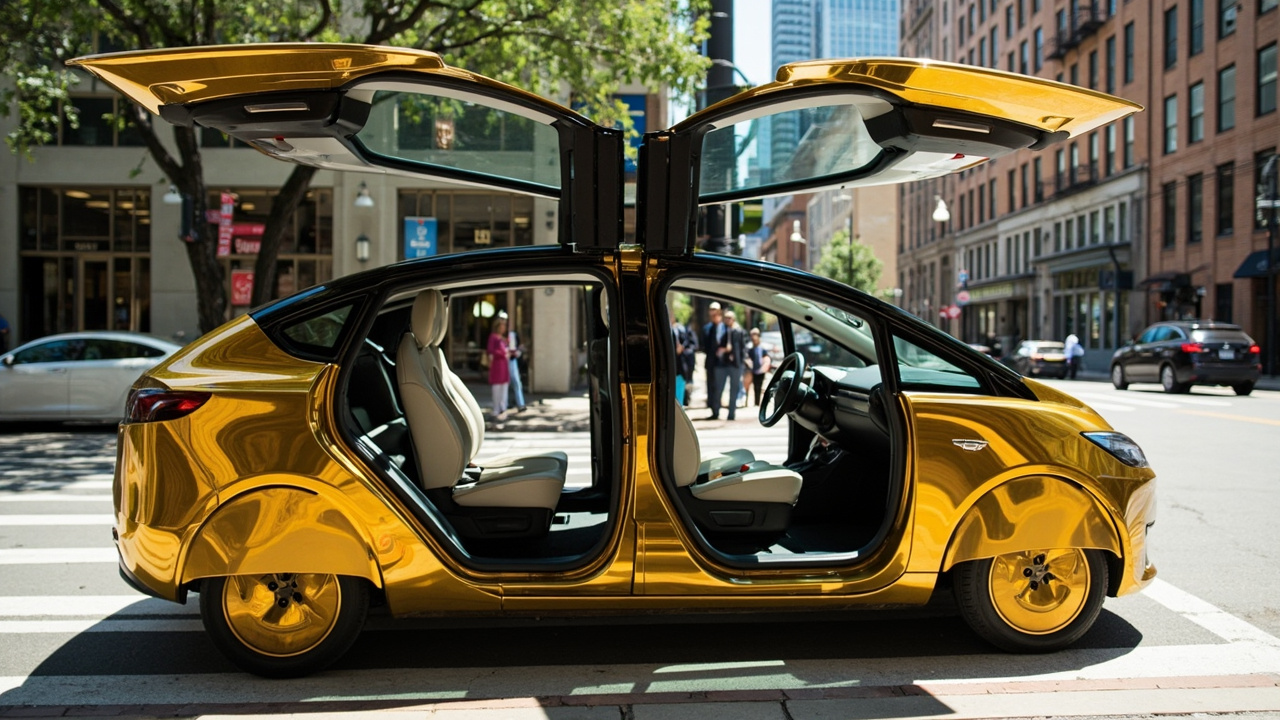
The Cybercab was first introduced in 2024 as a two-seat sedan with gullwing-style doors and eight cameras used to navigate without a driver, according to The Verge.
The production-intent vehicle lacks traditional controls such as a steering wheel, pedals and mirrors, according to The Verge.
It also lacks sensors commonly found on other robotaxis, including radar and lidar, according to The Verge.
Inside, the vehicle has bench-style seating for up to two passengers and a large touchscreen at the center of the dashboard, according to Engadget.
The design provides trunk space for luggage, scooters and other large items despite seating only two people, according to Engadget.
Lightest and most efficient Tesla to date
The Cybercab is the lightest and most range-efficient vehicle Tesla has produced, according to The Verge.
Documents filed with the Environmental Protection Agency describe a single front-mounted 219-horsepower permanent-magnet motor with front-wheel drive, according to The Verge.
The filings describe a compact 48-kilowatt-hour battery pack running at 326 volts, according to The Verge.
Curb weight is listed as 3,113 pounds, making the car roughly 700 pounds lighter than the lightest Model 3 on the market, according to The Verge.
That weight is roughly comparable to a gasoline-powered compact car despite the Cybercab carrying a lithium-ion battery, according to The Verge.
Camera-only driving and remote monitoring
The Cybercab uses a modified version of Tesla’s Full Self-Driving software, according to The Verge’s pre-launch analysis.
For Tesla’s private owners, Full Self-Driving remains a Level 2 driver-assist feature that requires human supervision, according to The Verge.
In the Cybercab, the system is monitored by remote operators who theoretically can intervene if a problem arises, according to The Verge.
The broader Full Self-Driving feature costs $99 a month and is still a Level 2 driver-assist system requiring constant human supervision, according to The Verge.
Tesla has said its Full Self-Driving software, a version of which runs Cybercabs, is up to 10 times safer than human drivers, according to Reuters.
Age rules: no children under 13 in Cybercab
Tesla launched a new website for its Robotaxi service that includes rules for riding in the new vehicle, according to The Verge.
One rule is that children under age 13 are currently banned from riding in the Cybercab, according to The Verge.
TechCrunch reported the same restriction, stating that Tesla does not allow minors under age 13 to ride in the vehicle “at this time,” according to TechCrunch.
Minors between ages 8 and 17 are allowed to ride in Tesla’s Robotaxi Model Y SUVs, according to TechCrunch.
Tesla publishes guidelines on child-seat use in both vehicles, according to TechCrunch.
Child seats and adult supervision
The Cybercab does not have standard LATCH anchors for child seats, according to TechCrunch.
Child seats in the Cybercab can be attached only with the seat belt, according to TechCrunch.
Tesla executives, including Musk, have discussed removing unnecessary parts to reduce costs, context noted by TechCrunch in connection with the missing anchors.
All children under 18 must be accompanied by an adult in both the Cybercab and the Model Y robotaxi, according to TechCrunch.
The reason for Tesla’s added caution around younger children in the Cybercab was not explained in the materials released that week, according to TechCrunch.
What Tesla says happens in a crash
Tesla’s documentation describes a sequence that follows a Cybercab crash, according to TechCrunch.
The airbags inflate, the doors unlock, the hazard-warning lights and interior lights turn on, and the high-voltage battery is disabled, according to TechCrunch.
The windows move to the “vent” position, the Cybercab applies the brakes to stop and park, and the infotainment system opens a two-way connection with Tesla’s rider support team, according to TechCrunch.
Door unlocking drew attention because Tesla has faced criticism over electronic door latches in the United States and China, according to TechCrunch.
In the prior month, Tesla had agreed to recall 3 million cars in China, alongside other automakers, following an investigation into electronic door latches that could trap occupants after a crash, according to TechCrunch.
Doors, manual releases and windows
The Cybercab uses electronic door latches that allow the doors to open automatically at the beginning or end of a ride, according to TechCrunch.
A small button on the vehicle’s exterior can be used to open the doors, according to TechCrunch.
Inside, the manual release is located on the armrest of each door, a placement TechCrunch described as obvious.
Tesla has separately faced criticism that interior manual door releases are difficult to locate in an emergency, according to TechCrunch.
The Cybercab’s windows “cannot be fully opened at this time,” with no explanation provided in that week’s documentation, according to TechCrunch.
Brake-by-wire and in-car power
Tesla is using a brake-by-wire system in the Cybercab, according to TechCrunch.
Instead of a hydraulic system that pumps fluid through lines to control brake pressure, the car uses electronic actuators controlling the brake calipers, according to TechCrunch.
Musk wrote in a post that electric brakes avoid hydraulic-system complexity because there is no need to route plumbing around the car, according to TechCrunch.
Tesla was already the first major automaker to use steer-by-wire on its Cybertruck, which removed the physical connection between the steering wheel and front wheels, according to TechCrunch.
The USB-C outlets in the Cybercab supply 90 watts of power, according to influencer Jeremy Judkins as cited by TechCrunch.
That output is roughly four times the power typically found inside a car, according to TechCrunch.
Accessibility and crash-test videos
Several videos were posted on Tesla’s social feeds showing the interior, crash-test worthiness and accessibility, according to The Verge.
One accessibility video showed a wheelchair user getting up to fold and stow his own wheelchair, a depiction The Verge described as befuddling, according to The Verge.
Several Cybercab vehicles were made available to Tesla influencers in Austin for content creation, according to The Verge.
The company had been testing the vehicles in various cities for months before the launch, according to The Verge.
Price, purchase and fleet plans
Two years before the launch, Musk said the two-seater would be available for purchase, perhaps for as little as $30,000, according to The Verge.
Tesla had still not said when the Cybercab would go on sale at the time of the Austin event, according to The Verge.
The company posted a new online form for parties interested in “future Robotaxi opportunities,” according to The Verge.
Those opportunities include purchasing a fleet of Cybercabs or building “mobility hubs and infrastructure,” according to The Verge.
There was no word on when regular customers could buy one for personal use, according to The Verge.
Manufacturing and unsupervised software timeline
Tesla started manufacturing the Cybercab in April, according to Reuters.
Musk promised that production would grow “exponentially” later in 2026 or next year, according to Reuters.
During Tesla’s first-quarter earnings call in 2026, Musk promised that “unsupervised” Full Self-Driving would be available to customer vehicles by the end of 2026, according to The Verge’s account of the truncated earnings-call remark.
The Cybercab vehicles operating in Austin are owned by Tesla, while future sales are planned, according to Engadget.
When the model was unveiled, Musk envisioned owners holding several Cybercabs and managing a fleet that could earn money through a ridesharing network, according to Engadget.
Regulatory scrutiny and federal standards
The National Highway Traffic Safety Administration had already opened an investigation into Tesla’s Cybercab rollout by launch week, according to TechCrunch.
Hours after the downtown Austin event, NHTSA said it opened an audit covering about 1,000 Cybercab vehicles to assess how Tesla determined compliance with federal vehicle-safety regulations, according to Reuters.
U.S. regulators limit commercial deployment of vehicles that do not meet decades-old federal safety standards written for human-driven vehicles and requiring manual controls, according to Reuters.
Unlike most other countries, where new models and technologies need clearance before launch, automakers in the United States can deploy vehicles on public roads by self-certifying compliance with federal standards, according to Reuters.
Self-certification and exemption cap
For vehicles that do not comply with safety standards, NHTSA offers an exemption process, but it caps deployment at 2,500 vehicles annually, according to Reuters.
Tesla engineering chief Lars Moravy said earlier in 2026 on X that the Cybercab would not be subject to that cap, without providing details, according to Reuters.
NHTSA had previously said Tesla had not applied for the exemption, according to Reuters.
That history prompted speculation that Tesla chose to self-certify, according to Reuters.
Amazon’s Zoox previously tried self-certification for a vehicle without driving controls; after NHTSA investigated, Zoox withdrew the claim and later received a federal exemption for limited commercial deployment in July, according to Reuters.
Prior promises and current availability
Musk claimed that 50 percent of the U.S. population would have access to Tesla’s robotaxis by the end of 2025, according to The Verge.
The vehicles were available in six cities in Texas and Florida at launch, according to The Verge.
Tesla is running a human-driven ridehail service in the San Francisco Bay Area but had yet to apply for a driverless testing permit from California, according to The Verge.
In 2016, Musk promised that every Tesla produced from then on would contain the technology necessary for self-driving, according to The Verge.
He later retracted that claim, acknowledging that hardware in some older vehicles was insufficient for autonomous operation, according to The Verge.
Retrofits, lawsuits and supervision
Musk promised to retrofit customers’ older vehicles but had yet to provide details on how that would work, according to The Verge.
Tesla faces multiple lawsuits from customers and regulators alleging that it misled the public about self-driving capabilities, according to The Verge.
Former Tesla employees who trained self-driving software told Reuters the system continued to struggle with basic maneuvers, according to Reuters.
Tesla’s Austin service had operated without a fatal accident, according to Reuters.