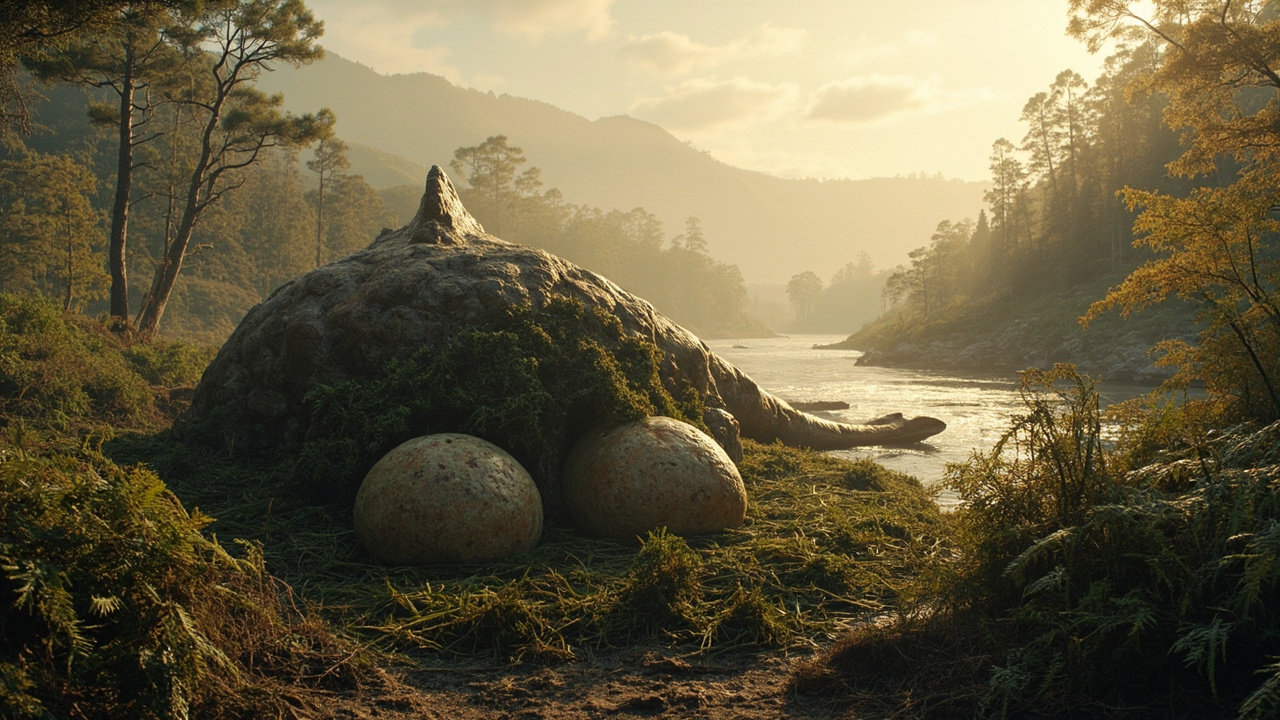
TL;DR: More than 250 titanosaur eggshell fragments from Argentina's Chorrillo Formation show the giant dinosaurs nested at about 55–60 degrees south latitude and warmed buried eggs with rotting vegetation.
The largest dinosaurs that ever lived nested hundreds of kilometres farther south than scientists had documented, and they kept their eggs warm without sitting on them. Researchers reporting in Royal Society Open Science described more than 250 eggshell fragments from the Upper Cretaceous Chorrillo Formation in southernmost Patagonia, Argentina, assigned to Fusioolithus oosp., an egg type linked to titanosaur dinosaurs, according to Royal Society Open Science. The site stood at approximately 55–60 degrees south palaeolatitude during the Maastrichtian stage of the Late Cretaceous, making it the highest-palaeolatitude area in the Southern Hemisphere to produce definitive dinosaur egg remains, according to Royal Society Open Science. Microscopic study showed high shell porosity, indicating the eggs were fully covered by nest material during incubation, with heat from microbial decay of buried vegetation rather than direct solar radiation, according to Royal Society Open Science.
The result changes the mapped range for sauropod nesting. Other Argentine sauropod egg sites represent nesting locations between 26–48 degrees south in low- to mid-palaeolatitudes, while the Chorrillo specimens extend sauropod nesting to higher palaeolatitudes, according to Royal Society Open Science. Most titanosaur eggs and eggshells, like those of other dinosaurs, had been found in lower-latitude regions closer to the equator, where warmer temperatures would have made incubation easier, according to CNN. The new work therefore shows reproduction by enormous plant-eating sauropods in a cool, strongly seasonal, high-latitude setting, according to CBC News.
Where the fragments were found
The fossils came from the Chorrillo Formation near the southern tip of South America in Santa Cruz Province, Argentina. Researchers discovered 255 eggshell fragments in the Chorrillo Formation in southern Argentina, according to CNN. The work was based on about 200 pieces of titanosaur eggs unearthed by a team of Japanese and Argentine paleontologists during an expedition in Patagonia that ran from 2020 to 2024, according to The Globe and Mail. In separate reporting on the same field program, fragments of Fusioolithus eggshells were found in the Chorrillo Formation in 2020 and 2024, according to CBC News.
Today the location is at a latitude of 50 degrees south, far enough from the equator to experience freezing temperatures during winter months, according to The Globe and Mail. Because the South American continent is currently shifting to the north, the site was even farther poleward at the time the eggs were laid, about 60 degrees south latitude, according to The Globe and Mail. The study itself places the area at approximately 55–60 degrees south palaeolatitude during that time interval, according to Royal Society Open Science. In another comparison, its latitude at the time would have been as far from the equator as Red Deer, Alberta, according to CBC News.
The rock formation dates back to the Late Cretaceous, 72 to 66 million years ago, just before the dinosaurs went extinct, according to CBC News. If observers had been present during the late Cretaceous, about 70 million years ago, a walking titanosaur would have been hard to miss, according to The Globe and Mail. The study authors place the specimens in the Upper Cretaceous Maastrichtian portion of the Chorrillo Formation, according to Royal Society Open Science.
What the shells are
The more than 250 eggshell fragments collected are assignable to Fusioolithus oosp., an ootaxon known from Late Cretaceous Gondwana regions that probably belongs to titanosaur dinosaurs, according to Royal Society Open Science. Volleyball-sized fossil eggs called Fusioolithus have been linked to titanosaurs and were previously found by the dozens in warmer climates, according to CBC News.
Titanosaurs were a group of gargantuan long-necked, long-tailed, plant-eating dinosaurs that lumbered on four legs and weighed up to 75 tonnes, or about half the mass of a blue whale, according to CBC News. Adults could weigh up to 75 tonnes, according to The Globe and Mail. Scientists describe these long-necked, small-brained, plant-eating giants as part of a group known as sauropods, according to CNN. Titanosaurs were plant-eating dinosaurs with species found on every continent, according to The Globe and Mail.
The Chorrillo eggs measured about four litres in volume, while the young still had a huge amount of growing to do after hatching to catch up with their giant parents, according to The Globe and Mail. The study team included Kohei Tanaka of the University of Tsukuba, Fernando Emilio Novas, Makoto Manabe, Chisako Sakata, Jordi Alexis Garcia Marsà and Darla K. Zelenitsky of the University of Calgary, according to Royal Society Open Science. The study was led by University of Tsukuba paleontologist Kohei Tanaka, Zelenitsky's former student, according to CBC News. Zelenitsky, an expert in dinosaur eggs and embryos, was among the researchers who examined the fossils, according to The Globe and Mail.
The paper was published online on Sept. 9, 2026, in the research journal Royal Society Open Science, after receipt on Feb. 14, 2026, according to Royal Society Open Science. The results were published Tuesday in the research journal Royal Society Open Science, according to The Globe and Mail. A separate report described a new study published on Wednesday by Zelenitsky and collaborators from Japan and Argentina, according to CBC News. The CNN report on the find was published Sept. 8, 2026, according to CNN.
Why sitting was impossible
Titanosaurs did not sit on their eggs to keep them warm with body heat, according to The Globe and Mail. They were too large to brood their eggs like birds, according to CBC News.
University of Calgary paleontologist Darla Zelenitsky, who has been studying the problem, said of the massive animals:
"They're too big."
Zelenitsky added of a crushed clutch:
"The nest would be one big omelette."
Smaller, feathered dinosaurs were thought to sit on their eggs like most modern birds and use their body heat, a method that would have been impossible for huge titanosaurs without crushing their relatively tiny eggs, according to CBC News. For the Chorrillo titanosaurs, sitting would have been disastrous for the clutch, according to The Globe and Mail.
Sea turtles bury their eggs on sandy tropical beaches to be warmed by the sun, an approach that would not work in cool, southern Argentina, according to CBC News. The researchers therefore tested whether the Patagonian titanosaurs used buried, vegetation-based incubation, according to CBC News.
Pores point to a buried mound
A study of the eggshells found them to be highly porous on microscopic scales, so they would have been prone to drying out if they were too exposed, according to The Globe and Mail. Eggshells have microscopic pores so the embryos can breathe, with larger and denser pores needed to let enough oxygen through when eggs are buried and less porous shells needed if exposed to open air to prevent drying, according to CBC News.
The researchers measured the porosity of the titanosaur eggshells from the Chorrillo Formation using an electron microscope and found they were very porous, suggesting they were buried, according to CBC News. The shells showed high porosity like those of titanosaur eggs studied previously, indicating the eggs were fully covered by nest substrate during incubation, according to Royal Society Open Science.
The team suggests the eggs were buried by titanosaur mothers under mounds of rotting vegetation, where breakdown of plant matter by bacteria would have generated additional heat, according to The Globe and Mail. By looking at microscopic pores, the researchers concluded titanosaurs used the same incubation technique used by modern crocodiles, burying eggs in warm piles of rotting vegetation, according to CBC News. Modern crocodiles and birds called megapodes bury their eggs in decomposing plant matter, where microbes generate heat as they break it down, according to CBC News.
The high latitude of the area in the Maastrichtian suggests the eggs were buried in a mound-style nest where microbial decay, rather than solar radiation, was the primary source of incubation heat, according to Royal Society Open Science. Zelenitsky had previously found evidence that hadrosaurs in Alberta used this technique, so the researchers examined whether titanosaurs in Argentina did as well, according to CBC News.
A cool, rainy river valley
While Earth was warmer overall at that time, the average annual temperature at the site would have been only about 12 degrees Celsius, roughly similar to modern-day Vancouver, according to The Globe and Mail. Its climate was described as similar to that of New York City today, while its latitude matched the distance from the equator of Red Deer, Alberta, according to CBC News.
Based on geochemical and fossil evidence, the location would likely have been a low-lying and rainy river valley, with relatively high humidity and large seasonal shifts in temperature and daylight hours because of its high latitude, according to The Globe and Mail. Fossils found there reveal a lush coastal plain ecosystem, according to CBC News.
The variability of food supply would have posed a challenge to titanosaurs aiming to give hatchlings a good chance at survival, according to The Globe and Mail. Zelenitsky said she was surprised by eggs so far from the equator, noting that larger animals need more resources to survive and reproduce, according to CBC News. The dinosaurs likely timed breeding to lay eggs during spring, according to The Globe and Mail.
The problem is that dinosaurs needed to keep eggs warm for embryos to develop and hatch, for up to many months, according to CBC News. Few discoveries have yielded fossil evidence of non-avian dinosaurs nesting at high palaeolatitudes, where low seasonal temperatures and prolonged periods of reduced sunlight probably posed nesting challenges, according to Royal Society Open Science.
Neighbors in the far-south ecosystem
Fossils from the Chorrillo Formation reveal roaming dinosaurs including the titanosaur Nullotitan glaciaris, up to 25 metres long, along with the smaller two-legged herbivore Isasicursor santacrucensis, tyrannosaur-like megaraptors and small birds, according to CBC News. They would have lived among crocodiles, snakes, turtles, frogs, fish, mammals, snails and insects, according to CBC News.
Numerous Argentine sites containing eggs or eggshells of mainly sauropod dinosaurs, in oofamilies Faveoloolithidae, Fusioolithidae and Megaloolithidae, have been found in the Allen, Anacleto, Bajo de la Carpa, Ciénaga del Río Huaco, Chorrillo, Los Alamitos and Los Llanos formations, according to Royal Society Open Science. The palaeolatitudes of those sites, except those in the Chorrillo Formation, are reported to represent nesting locations between 26–48 degrees south, according to Royal Society Open Science.
Dinosaur egg remains are rarely found in areas of high palaeolatitudes, with Canada at approximately 57–60 degrees north and Siberia at approximately 70–75 degrees north yielding the most poleward occurrences, according to Royal Society Open Science. Nesting in northern polar environments is evidenced by hadrosaur and theropod eggshells from a Late Cretaceous site in Siberia at approximately 70–75 degrees north, as well as theropod perinatal bones and small hadrosaur tracks and perinatal bones from Upper Cretaceous deposits of Alaska, according to Royal Society Open Science. Fossilized eggshell and perinatal bones of hadrosaur and theropod dinosaurs found in Alberta, Canada, indicate relatively high-latitude nesting at approximately 57–65 degrees north, according to Royal Society Open Science.
In the Southern Hemisphere, less evidence exists for high-latitude nesting, in part owing to the lack of definitive dinosaur eggshells or eggs from regions of Antarctica or Australia, according to Royal Society Open Science. Argentina, which has yielded abundant dinosaur eggs, represents a promising region for uncovering fossil evidence of high-latitude nesting, according to Royal Society Open Science.
Why the southernmost eggs matter
Zelenitsky called the Chorrillo material the most southern site to produce dinosaur eggshells and said it provides evidence needed to show dinosaurs were nesting in the area, according to The Globe and Mail. The Chorrillo Formation represents, to the authors' knowledge, the highest palaeolatitude area to produce definitive dinosaur egg remains from the Southern Hemisphere and reveals titanosaurs were nesting at higher latitudes than previously known, according to Royal Society Open Science.
Robert Reisz, a University of Toronto paleontologist who was not involved in the study, said the research was noteworthy for shedding light on reproductive strategies of dinosaurs living far from the tropics, according to The Globe and Mail. The study shows how adaptable dinosaurs were, with even the largest dinosaurs finding a way to reproduce not only in lower-latitude environments but also in higher-latitude environments that are usually more challenging, according to CBC News.
Tsu-Ruei Yang, associate curator of vertebrate paleontology at Taiwan's National Museum of Natural Science, published a study earlier in 2026 suggesting feathered dinosaurs called oviraptors used both sunlight and body heat to incubate eggs, according to CBC News. In comments on the new work, he said he was not surprised titanosaurs were nesting so far from the equator because they were a very successful group, according to CBC News.
Sources referenced
- Titanosaur eggshells from the latest Cretaceous of Patagonia, Argentina: implications for nesting at high latitude - Royal Society Open Science (https://royalsocietypublishing.org/rsos/article/13/9/260333/483231/Titanosaur-eggshells-from-the-latest-Cretaceous-of)
- The biggest dinosaurs couldn't sit on their eggs. Scientists say they did this instead - CBC News (https://www.cbc.ca/news/science/titanosaur-eggs-9.7336841)