TL;DR: Defense startup Covenant on September 9, 2026 unveiled Anthem, a ground-launched cruise missile with a payload of more than 200 kilograms that it aims to build by the thousands at a mid-six-figure unit price.
Startup exits stealth with heavy-payload missile
Defense startup Covenant ended two years of secret development on Wednesday, September 9, 2026, when it publicly introduced a long-range cruise missile named Anthem, according to Reuters.
The Washington-based company, founded in 2024, said Anthem is a ground-launched system built to carry a heavy payload over long distances and to be manufactured in large numbers at relatively low cost. Covenant described Anthem as a deep precision strike weapon meant to attack hardened targets in volume, rather than as a small tactical munition.
Covenant has raised just over $250 million over three funding rounds, according to CNBC. Investors named across the announcements include Andreessen Horowitz, Founders Fund, Lux, 8VC, Aleph, Lightspeed and Altimeter Capital. Peter Thiel's Founders Fund is among the backers identified by CNBC.
The company now employs more than 200 people across the United States, Germany and Israel. Its leadership includes co-founder and Chief Executive Michael Kaufman, co-founder Ofir Dayan, and President and Chief Growth Officer Abby Denburg.
In an interview cited by Reuters, Kaufman said comparable weapons from the largest contractors were being produced in limited numbers at high prices, and that Covenant had set out to change that approach. The company said Anthem was designed from the start for affordable storage, fielding and large-scale production, not only for flight performance.
What Anthem is designed to do
Anthem carries a payload of more than 200 kilograms, or about 441 pounds, according to Reuters. Covenant says the payload is large enough to damage hardened facilities such as production sites, airstrips and ports that require penetrating power.
In operational use, Anthem would be employed in high volumes alongside other long-range missiles, according to Reuters. Those existing systems include the 1,000-mile, or 1,609-kilometer, Tomahawk cruise missile produced by RTX's Raytheon unit and the 600-mile Lockheed Martin Joint Air-to-Surface Standoff Missile-Extended Range, known as JASSM-ER.
Covenant executives said the missile was developed with Pacific operations in mind, according to Reuters. Denburg said the system was designed for a conflict involving China.
Military planners envision ground-launched weapons striking from allied islands near China, such as the Philippines, according to Reuters. That geography covers a stretch of roughly 2,000 miles that would place targets in China within reach without dependence on crewed aircraft or naval strike groups.
Covenant pairs Anthem with a proprietary ground-based launcher sold at an additional price, according to DefenseScoop. Company officials declined to specify the exact price of the missile or the launcher, beyond describing the missile price as mid-six figures at full-rate production.
An executive alluded to an ability to collaboratively home on targets, but declined to explain that feature, according to DefenseScoop. The company also declined to disclose the missile's range.
How the missile flies
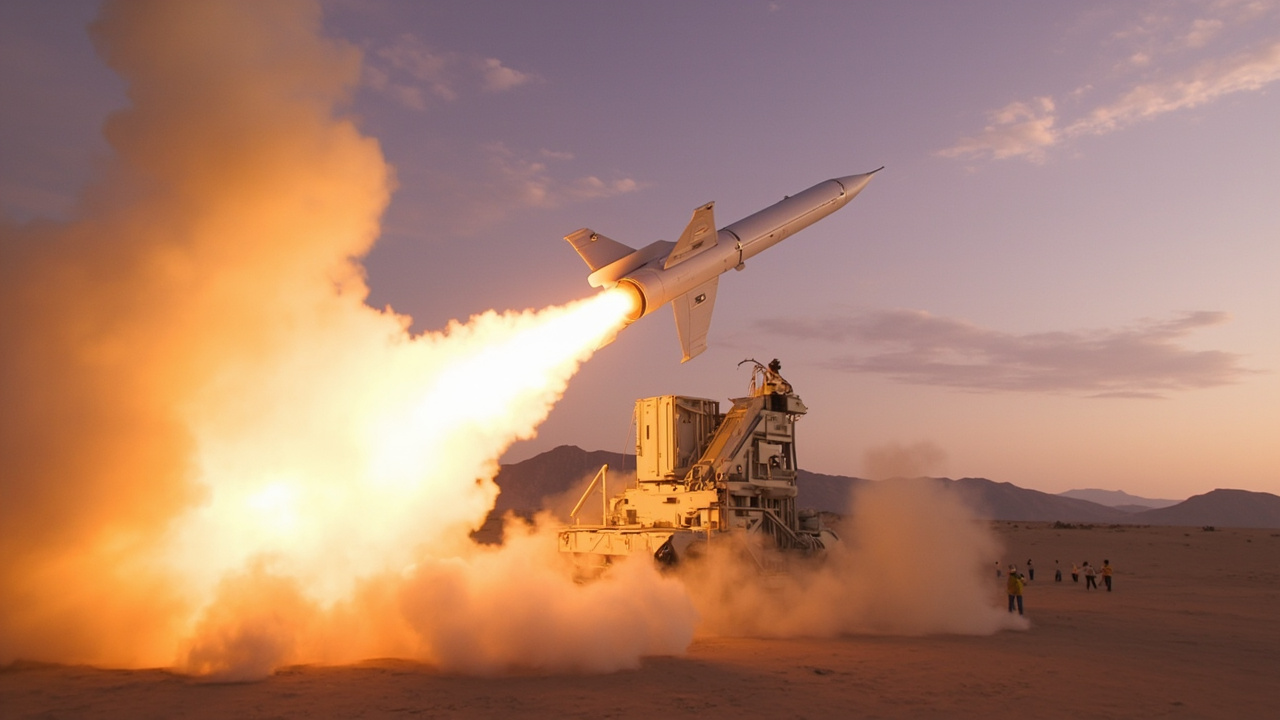
Anthem uses a solid rocket motor for takeoff and a heavy-fuel jet engine for cruise flight, according to Reuters.
Covenant says it has flown the missile more than 200 times over the past year in tests, according to Reuters. The company's account published through Andreessen Horowitz places Anthem's maiden flight in August 2025 and says the test campaign has included multiple flight tests with the U.S. military on U.S. soil and abroad.
A handout image distributed for the announcement shows Anthem making a test flight at a Covenant range at an undisclosed location on June 30, 2026, according to Reuters.
Army and company officials also discussed a recent test at a new range in Morocco conducted with less than two weeks' notice from the service, according to DefenseScoop. Covenant said that demonstration took place last month.
Covenant said most of Anthem's parts are commercial off the shelf, according to DefenseScoop. Where commercial parts were not available, the company said it either brought the part in-house or worked with a supplier to establish a new production line to meet expected demand.
Beyond the missile and launcher hardware, Covenant said it is also providing mission-planning and command-and-control software intended to support mass strike missions, according to the company's announcement summarized by Andreessen Horowitz. The company said it devoted substantial attention to storage and handling so the system could be kept and deployed in the thousands.
Why Covenant says mass matters now
The announcement coincides with efforts by the United States and allies to rebuild missile inventories with less expensive and more plentiful long-range precision-strike weapons after the war in Iran depleted stocks, according to Reuters.
CNBC reported that the war in Iran had stretched into its seventh month and that U.S. weapons stockpiles were rapidly dwindling, citing multiple reports. The company's announcement through Andreessen Horowitz said the United States fired more than 1,000 Tomahawk cruise missiles in the first five weeks of the war against Iran.
Denburg pointed to growth in short-range, low-payload drones made prominent by the Russia-Ukraine war, according to CNBC. She said there was a gap between those systems and expensive strategic weapons, describing affordable mass at strategic range as the opening Anthem was intended to fill.
In an interview with DefenseScoop, Denburg said customers should not need their most exquisite systems to strike production facilities, airstrips and ports, because those target sets can require tens, dozens or hundreds of munitions. She said target sets across the Middle East, Asia and Europe were hardened enough to require the penetrating capability of 200 kilograms or more.
Covenant framed Anthem as a response to what it called the biggest gap in Western arsenals for deep precision strike, according to DefenseScoop. Chief Executive Michael Kaufman said in a statement cited by DefenseScoop that the company spent the prior two years building Anthem to fill that gap.
Top defense and administration officials have denied that the United States faces a munitions shortfall or is unprepared to fight peer adversaries, according to DefenseScoop. At the same time, service officials have sought to diversify munitions types through what they describe as a high-low mix of expensive systems and cheaper missiles that can be deployed in bulk.
Texas factory opens as production hub
Covenant announced September 9 the opening of a 105,000-square-foot factory in Dallas, Texas, to accelerate lower-cost missile manufacturing for the U.S. military, according to CNBC. The Dallas site spans 9,754 square meters, according to Reuters.
The Dallas factory will serve as the company's American production line and supply chain, according to the company's announcement. Covenant said the plant opens on Wednesday and is expected to reach full-rate production of 5,000 missiles per year.
For the first year, Covenant plans to produce 1,000 Anthem missiles at the Dallas factory, according to CNBC. Serial production is scheduled to begin in the first quarter of 2027, with output eventually scaling to 5,000 missiles annually.
The company currently operates production facilities in Germany and northern Israel, according to CNBC. It employs more than 200 workers worldwide.
Covenant operates a similar-sized facility in Saxony, Germany, which will also have annual capacity of 5,000 units, according to Reuters. A smaller site in northern Israel will make 2,000 units per year. The company's announcement places the German facility at 110,000 square feet and the Israel facility at 30,000 square feet.
The German plant will feature an almost entirely European supply chain, according to the company's announcement. A separate Reuters report on the German operation said materials for German-built Anthems would be largely European.
Orders, deliveries and Pentagon agreements
Covenant has already booked roughly $150 million in orders, according to Reuters. Those orders include research and development as well as production contracts, according to DefenseScoop.
The company expects to begin generating revenue in 2027 as deliveries increase, according to Reuters. An international customer is due to begin taking delivery of German-built Anthems by the end of this year, with U.S. Army deliveries expected in 2027, executives said, according to Reuters.
Covenant also announced two Department of Defense agreements on Wednesday, according to CNBC. One is intended to accelerate a test and qualification program with the Army, while the other involves work with the Navy to adapt Anthem for maritime use.
Lt. Gen. Frank Lozano, the Army's portfolio acquisition executive for the fires program, said Wednesday that he was impressed with the system and that it was among the capabilities the service is examining, according to DefenseScoop. He said the Army was reviewing capabilities across different ranges, warhead effects, velocities and price points, and that he did not want to limit the service to a single cruise-missile solution.
Lozano referred to a $500,000 Covenant cruise-missile solution during his remarks, according to DefenseScoop. A Covenant representative said he could not confirm that figure and reiterated that Anthem's cost was in the mid-six figures.
Lozano also referenced a prototype agreement with Covenant for further demonstration in fiscal 2027, according to DefenseScoop. Covenant officials said customers were demanding systems in 2027 and systems at scale in 2027, making rapid and sustained production a central requirement.
Supply chain built to avoid bottlenecks
Munitions manufacturers have long cited supply-chain bottlenecks that constrain rapid and sustained production of expensive systems, particularly for solid rocket motors, according to DefenseScoop. Anthem also uses a solid rocket motor.
Covenant said it deliberately avoided sole-source suppliers, according to Reuters. The company has lined up three solid-rocket-motor providers, with a fourth in development, and has secured long-term agreements for more than 4,000 jet engines over the next two years.
Denburg said Covenant identified those risk components early and invested heavily in supply-chain partnerships capable of supporting low-cost production without reducing quality, according to DefenseScoop. She did not identify suppliers or describe the agreements in detail, but said none of Anthem's components depended on a single source.
New defense companies often struggle to gain traction as they challenge established suppliers with new technologies and can encounter substantial difficulties delivering products, especially in large quantities, according to Reuters.
Covenant said local production was part of its strategy for addressing that challenge, with Anthems produced locally for customers so they would be available when each country needed them. The company said its priority was placing thousands of Anthems in the field quickly, beginning with thousands of deliveries per year starting in 2027.
Sources referenced
- Silicon Valley-backed Covenant unveils low-cost, mass-producible cruise missile | Reuters (https://www.reuters.com/business/aerospace-defense/silicon-valley-backed-covenant-unveils-low-cost-mass-producible-cruise-missile-2026-09-09/)
- Defense tech firm Covenant opens U.S. missile factory, exits stealth - CNBC (https://www.cnbc.com/2026/09/09/defense-tech-covenant-anthem-missile.html)