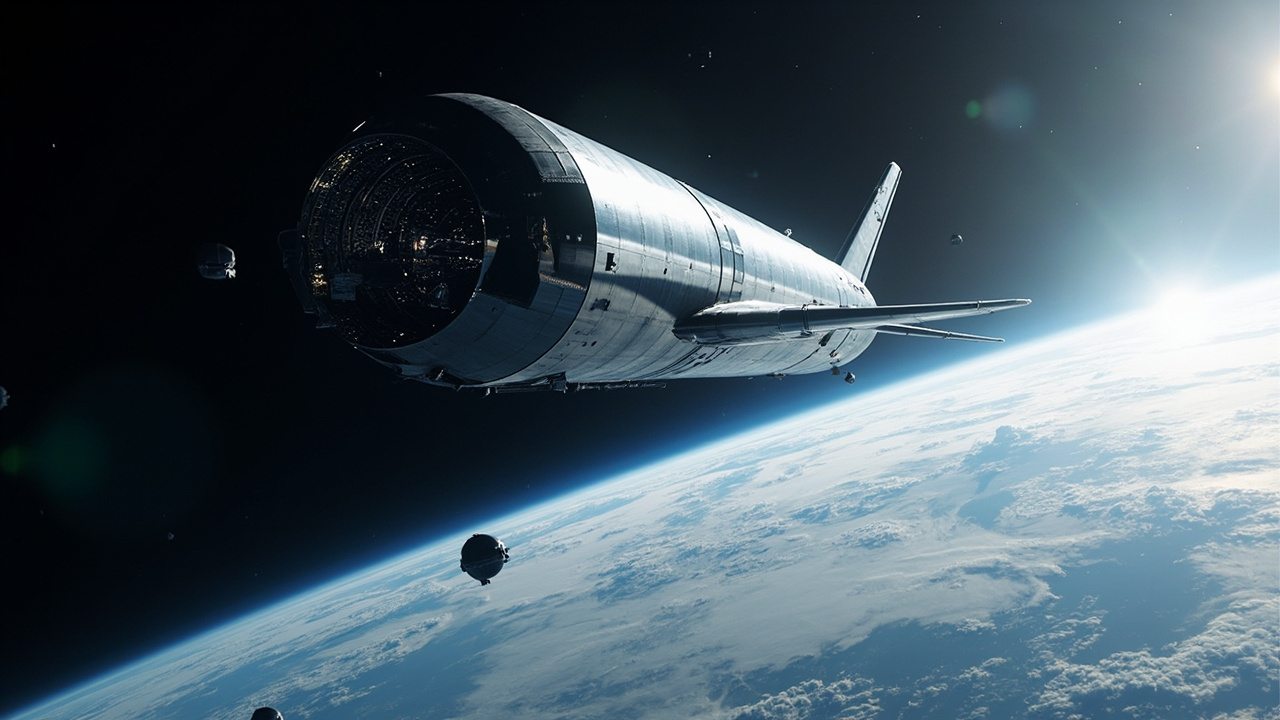
TL;DR: SpaceX's Starship reached orbit for the first time on Sept. 28, 2026, deploying 26 Starlink V3 satellites on its 14th flight before a shortened three-hour mission ended in the Pacific.
First orbital flight ends early but hits key goals
SpaceX's giant Starship vehicle entered Earth orbit for the first time on Monday, Sept. 28, 2026, and released its first operational payload before controllers cut the mission short, according to Reuters.
The uncrewed flight was the 14th test of Starship and the first planned to reach orbit. The company had scheduled a 10-hour mission and later reduced it to three hours after an engine shut down early, according to Reuters.
The flight still delivered 26 next-generation Starlink satellites one by one at about 269 km, or 161 miles, altitude, marking the ship's first orbital deployments, according to Reuters.
SpaceX founder Elon Musk wrote on X that all 26 Starlink V3 operational satellites deployed and were operating nominally, according to Reuters.
Dean Sladen, quality manager and aerospace engineer at Accu Components, said deploying all 26 satellites into the target orbit was a huge win and described the flight as Starship's very first revenue-generating commercial flight, according to Reuters.
The mission combined a high-stakes test with an operational delivery carrying millions of dollars' worth of Starlink hardware, even though the final design remains under development, according to Reuters.
Unlike past flights, Monday's mission carried real commercial payload value. Analysts estimated the new V3 satellites represented hundreds of millions of dollars in projected revenue based on added customer capacity, according to Reuters.
SpaceX shares fell 2% on Monday, according to Reuters. The company was valued at $2 trillion as of Friday's close, according to Reuters.
Where and when Starship left the pad
The 40-story-tall vehicle, made up of a Super Heavy booster topped by the Starship upper-stage vessel, lifted off from SpaceX's Starbase complex along the Gulf of Mexico near Brownsville, Texas, according to Reuters.
SpaceX launched Starship from a pad in Texas on Monday just before 9 a.m. Eastern time, according to the company's live feed cited by The Wall Street Journal.
The Starbase site at Boca Chica Beach in Texas hosted the launch, according to NPR. The upper vehicle is 171 feet tall, according to NPR, while the full stack measures 407 feet tall, or 124 meters, according to Space.com.
At 7:48 a.m. CT, the Super Heavy booster ignited its 33 rocket engines to begin the 14th flight, according to NPR.
About two-and-a-half minutes after launch, Starship separated from the booster and continued toward space, according to NPR.
No one was on board for the mission, according to NPR.
The booster did not attempt a catch at the launch tower. Super Heavy is designed to be reusable by returning to its launch site for capture by the launch tower, but this booster simulated a landing offshore in the Gulf of Mexico, according to NPR.
SpaceX was testing upgrades to the booster's software and hardware during the flight, according to NPR.
The Super Heavy lofted the upper stage toward space before returning itself to Gulf waters for an engine-controlled splashdown, according to Reuters. That followed hard landings for the booster on two previous missions, according to Reuters.
Some engines on that booster stopped working during its descent, SpaceX said, according to Reuters.
Engine shutdown forced a rapid replanning
Upon reaching space, one of Starship's three main engines shut down prematurely following separation from the lower-stage Super Heavy booster, according to Reuters.
SpaceX spokesperson Dan Huot initially announced on the company's live stream that the craft would be unable to reach orbit, according to Reuters.
"The team has made the call not to commit to orbit," Huot said, according to Reuters.
Huot reversed course minutes later after engineers confirmed that other onboard engines could still boost the craft into orbit, which Starship then did, according to Reuters.
A separate account said one of the six engines on Starship failed during ascent, prompting SpaceX to evaluate whether to continue, according to NPR. About 22 minutes into the flight, the team decided it was safe to proceed to orbit, according to NPR.
Engine issues have appeared on some previous suborbital Starship flights in space, according to Reuters. The report described propulsion in space as a lingering challenge for the program in an area important to maneuvering in space, according to Reuters.
That maneuvering function is less critical for low-orbiting Starlink deployments but is crucial for future assignments carrying NASA astronauts to the moon, according to Reuters.
It was unclear how much of a setback the engine failure, the latest glitch since test flights began in 2023, would pose for the goal of putting the spacecraft into routine service later this year, according to Reuters.
Out of caution, managers shortened the time in orbit. SpaceX had planned a 10-hour flight including six orbits at about 170 miles altitude, but after launch mission managers cut the flight to three hours, according to NPR.
In a blog post, SpaceX explained the decision: "Out of an abundance of caution given the engine issue experienced during ascent, the flight control team decided to limit the duration spent on orbit and proceeded with deorbiting Starship to a splashdown location in the northern Pacific Ocean," according to NPR.
Monday's launch profile included portions that would allow Starship to abort its orbital trajectory and return safely, according to NPR.
Flight 14 was the first time the vehicle reached orbital speed of about 17,500 mph, according to NPR. All 13 previous test flights since 2023 had been limited to suborbital space, according to Reuters.
First revenue payload: 26 Starlink V3 satellites
Once in orbit, Starship deployed its 26 satellites individually, according to Reuters. Musk said the spacecraft delivered the satellites to the target orbit and that they were operating nominally, according to Reuters.
The satellites were Starlink V3 next-generation spacecraft joining a constellation of thousands of internet satellites providing broadband access worldwide, according to NPR.
SpaceX presently operates more than 11,000 Starlink satellites in low Earth orbit, by far the largest spacecraft network ever assembled, according to Space.com.
The V3 generation is substantially larger and more capable. The satellites weigh roughly 4,400 pounds, or 2,000 kilograms, about twice as heavy as their predecessors, according to Space.com.
They can fly efficiently only on Starship because they are too large to launch aboard the workhorse Falcon 9 rocket that built the original constellation, according to Space.com.
SpaceX regularly launches Starlink satellites from Florida and California using Falcon 9, according to NPR. The company announced the final mission from Florida last month and plans to use Starship from Florida's Space Coast in the future, according to NPR.
Only Starship can launch the larger V3 version, according to NPR.
According to SpaceX, the V3 satellites deployed Monday can handle 10 times more data than their predecessor V2 mini-sats that the company has launched 20 or 30 at a time on Falcon 9 rockets, according to Reuters.
The company wants to launch the V3 spacecraft in batches of 60 per launch once Starship enters routine operation, according to Reuters.
SpaceX representatives said the V3 satellite is designed to support 1 Tbps of downlink and 160 Gbps of uplink capacity, representing about a tenfold improvement in downlink and about a 22-fold increase in uplink from the V2 satellite, according to Space.com.
The V3 antennas support both 2,048 downlink and uplink beams, compared with 192 downlink and 144 uplink beams for the V2 phased arrays, according to Space.com.
Because of those and other enhancements, SpaceX said it will be able to deploy about 20 times the capacity per Starship launch into the constellation compared with a Falcon 9 launch of V2 satellites, according to Space.com.
The eventual V3 constellation is expected to consist of about 100,000 satellites, according to SpaceX founder and CEO Elon Musk cited by Space.com. At about 60 V3 spacecraft per mission, reaching 100,000 would require nearly 1,700 liftoffs, according to Space.com.
More launches will be needed to maintain the network because Starlink satellites have an operational lifetime of about five years and must be replaced regularly, according to Space.com.
Heat shield cameras and Pacific splashdown
SpaceX used the flight to test key Starship systems, including its heat shield, according to NPR.
Three of the Starlink satellites carried cameras to capture data on the heat shield, according to NPR. Surviving reentry is central to plans for spacecraft reusability, according to NPR.
Starship made a controlled descent into the Pacific, according to Reuters. The maneuver ended with a thruster-driven flip that placed the vehicle vertically so it struck the sea in a nose-up position, according to Reuters.
Fire engulfed the base as it touched down before the vehicle tipped on its side, followed by a large fireball, according to Reuters. The company had not planned to recover and reuse the spacecraft from the sea, according to Reuters.
The splashdown occurred north of Hawaii, according to NPR, in the northern Pacific Ocean, according to NPR's account of the SpaceX blog post.
NASA administrator Jared Isaacman congratulated SpaceX on getting the ship to orbit and managing every step in a safe, responsible and especially inspirational way, writing on X, according to Reuters.
Sladen said the engineering story was how the team handled the ascent engine failure, according to Reuters.
Why orbit mattered after 13 suborbital tries
Reaching orbit is a primary benchmark for any new rocket intended to deliver payloads, according to Reuters. For Starship, the feat was long delayed, according to Reuters.
Musk once predicted orbital flight would be achieved in 2022, followed by satellite deployments in 2023, according to Reuters.
Instead, the program conducted a nearly decade-long development campaign costing more than $15 billion to date, according to Reuters. All flights before Monday remained suborbital, according to Reuters and NPR.
Musk has said he envisions ultimately flying hundreds or thousands of Starship missions per year, a pace described as unprecedented in the space industry, according to Reuters.
"Starship is 2 to 3 years away from hourly flights," Musk wrote on X on Sunday, according to Reuters.
SpaceX also aims to launch Starship 10,000 times per year by 2030, Musk has said, according to Space.com. The company considers that cadence possible because the vehicle is designed to be fully and rapidly reusable, according to Space.com.
For perspective, the Falcon 9 flew 165 times in 2025, a company record representing half of all orbital missions worldwide that year, according to Space.com.
Starship was built to launch Starlink satellites more frequently and to carry future NASA missions to the moon, according to Reuters. Starship is key to SpaceX's commercial success and NASA's plans to land humans on the moon, according to NPR.
Missions to the moon and Mars will require the upper-stage ship to be refueled in Earth orbit, something the company had not yet demonstrated as of the flight, according to Space.com.
The ship will also need a life-support system before carrying humans, along with test flights to demonstrate that it works, according to Space.com. SpaceX has flown 20 astronaut missions aboard its Crew Dragon capsule, which generally carries four people per flight, according to Space.com.
Public company context and expansion plans
Starship's orbital debut came three months after SpaceX went public with a record-shattering initial public offering in June, according to Reuters.
That offering made SpaceX the sixth-biggest U.S. company by value and turned Musk, who founded the company in 2002, into the world's first trillionaire, according to Reuters.
In filings to the Federal Election Commission ahead of the June IPO, the company underscored Starship's role in growth plans, according to NPR. The filing stated: "Any failure or delay in the development of Starship at scale or in achieving the required launch cadence, reusability and capabilities thereafter would delay or limit our ability to execute our growth strategy," according to NPR.
SpaceX announced plans to build a massive facility in Louisiana aimed at launching Starship, according to NPR. The company described a $100 billion investment including dozens of launch pads, with a goal of sending Starship from Starbase, Louisiana, beginning in 2029, according to NPR.
SpaceX also intends to operate a million Starmind AI data centers in Earth orbit, all to be carried by Starship, according to Space.com.
Monday's deployment began construction of the V3 megaconstellation, according to Space.com. The mission showed Starship moving from a research-and-development phase toward carrying revenue-generating payloads, according to The Wall Street Journal.
Sources referenced
- SpaceX's Starship makes orbital debut deploying Starlinks before early ending | Reuters (https://www.reuters.com/business/media-telecom/spacexs-starship-launches-14th-flight-first-headed-orbit-2026-09-28/)
- SpaceX’s Starship launches on first orbital mission from Texas : NPR (https://www.npr.org/2026/09/28/nx-s1-5983418/spacex-starship-first-orbital-flight-14-nasa)