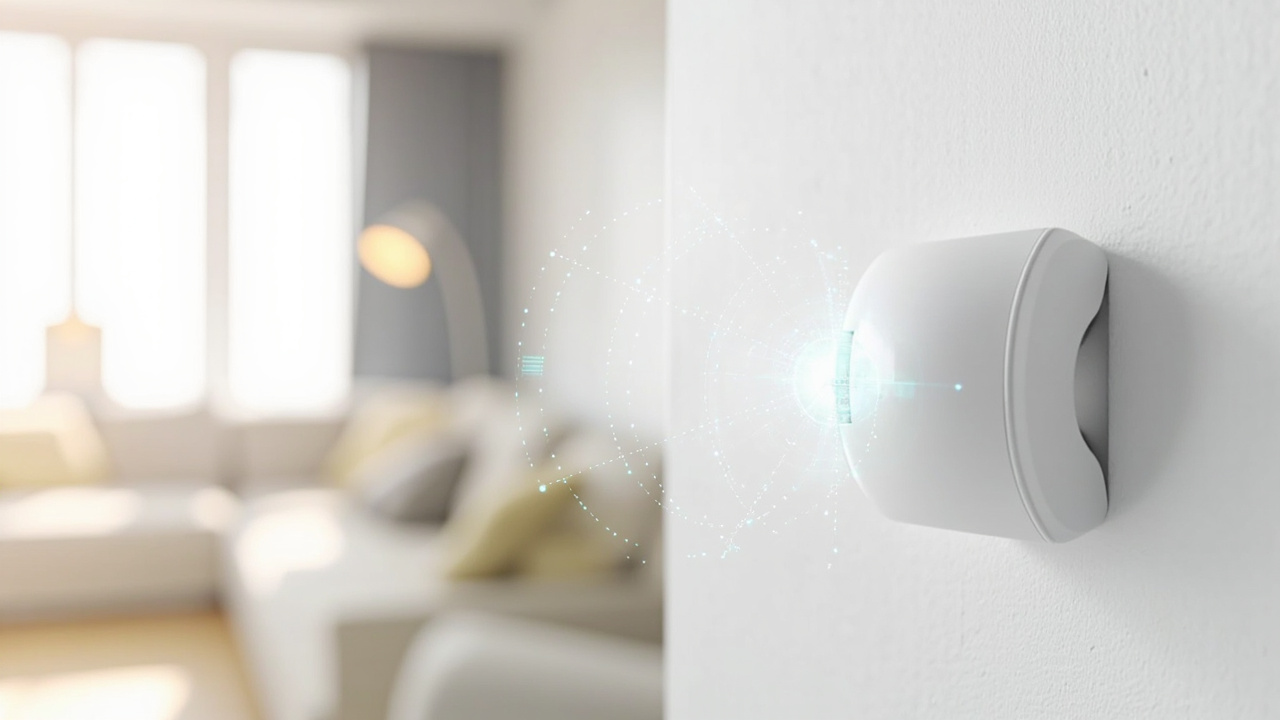
TL;DR: Shelly's $84.99 Presence Gen4 uses mmWave radar to track up to 10 people across 10 zones without a camera.
A new room sensor that counts people without filming them
Shelly announced the Shelly Presence Gen4 on Oct. 15, 2026, according to The Verge. The device uses millimeter-wave radar rather than a camera to detect presence, motion and activity for people and pets. The announcement followed the launch of its $50 subscription-free security camera last month, according to The Verge. The Bulgarian smart home specialist unveiled the sensor as a way to trigger automations based on where people are, rather than by simply detecting movement, according to Forbes reporting carried by Yahoo Tech. The sensor is designed to sense actual presence rather than just motion for more natural room automation, according to Shelly USA documentation. It is designed for precise, room-aware automations with customizable detection behavior for both real rooms and open spaces, according to Shelly USA documentation. The product name is Shelly Presence Gen4, the model is S4SN-0U61X, the default device SSID pattern is ShellyPresence-XXXXXXXXXXXX and the BLE ID is 0x1821, according to Shelly USA documentation. The available colors are white and black, according to Shelly USA documentation. The shell uses plastic with an aluminum back, according to Shelly USA documentation.
Why stillness no longer means empty
Conventional motion sensors often switch lights off when someone is sitting still on a sofa, working at a desk or reading in bed because they rely on movement to register occupancy, according to Forbes reporting carried by Yahoo Tech. Traditional passive infrared sensors detect changes in infrared radiation as people move through a space, which means someone sitting still can eventually disappear from view, according to Forbes reporting carried by Yahoo Tech. Shelly Presence Gen4 uses mmWave radar to reliably detect people even when they are sitting still, according to Shelly USA documentation. The new sensor can detect people who are stationary and then use their location to trigger automations, according to Forbes reporting carried by Yahoo Tech. Millimeter-wave radar is increasingly being used in smart home sensors as an alternative to traditional motion detection, according to Forbes reporting carried by Yahoo Tech. Millimeter-wave radars can detect much smaller movements, including subtle movements associated with breathing, so the technology could tell if someone is in a room even if completely still, according to Forbes reporting carried by Yahoo Tech. True presence detection in quiet settings is listed as ideal for bedrooms, offices or meeting rooms where people remain still, according to Shelly USA documentation. The approach enables hands-free room automation in which entering a room can trigger lights, air conditioning or music without switches or voice commands, according to Shelly USA documentation. Privacy-friendly occupancy awareness allows monitoring of when and where people are present without using cameras, according to Shelly USA documentation. Sensitive spaces listed for that camera-free approach include restrooms, bedrooms and offices, according to Shelly USA documentation.
Ten people, ten zones, one map
The sensor identifies up to 10 separate people simultaneously for multi-occupant automations, according to Shelly USA documentation. It supports up to 10 customized detection zones for area-specific automations, according to Shelly USA documentation. The zones are independently customizable, according to The Verge. Shelly's new sensor maps occupancy within a room, allowing automations to respond to specific areas rather than treating the entire space as one detection zone, according to Forbes reporting carried by Yahoo Tech. Detected people are visualized on a map for real-time understanding of the space, according to Shelly USA documentation. Zone-based smart lighting can light only the areas in use, a layout described as suited to large rooms, studios or open-plan homes, according to Shelly USA documentation. A lamp can be set to turn on only when someone sits at a desk, according to The Verge. A home theater can be set to power up only when someone sits on a living room sofa, according to The Verge. Lights can turn on around a desk when a person sits down to work in the morning, while neon lights and speakers can activate in the evening after moving to a gaming rig, according to Forbes reporting carried by Yahoo Tech. A movie-time automation can run when settling on a couch after 9 p.m., according to Forbes reporting carried by Yahoo Tech. A coffee machine can be set to start when two people are both in the kitchen in the morning, according to Forbes reporting carried by Yahoo Tech. Energy efficiency in empty spaces is supported by automatically turning off appliances and lights when no one is present, according to Shelly USA documentation. Automations for turning on lights, heating, cooling or music can trigger when a person enters a space and turn off again when they leave to conserve power, according to The Verge.
Light levels, pets and vacuum cleaners
The device includes a built-in light sensor that reports dark, twilight and bright states for lighting-aware automations, according to Shelly USA documentation. Ambient light-aware scenes can trigger different scenes based on light levels, such as soft lighting during twilight or full brightness when dark, according to Shelly USA documentation. An adjustable ambient light sensor reports whether conditions are dark, at twilight or bright, according to Forbes reporting carried by Yahoo Tech. Filtering options ignore near-ground movement and avoid detecting small objects such as pets or robot vacuum cleaners, according to Shelly USA documentation. Users have the option to include small objects like pets when detected, according to The Verge. Sensitivity can also be adjusted so the sensor ignores objects low to the ground, according to The Verge. That low-ground setting is described as a way to ensure automations are not triggered while a robovac cleans the floor, according to The Verge. Adjustable height thresholds and other sensitivity settings can help filter out pets, robot vacuums and other low-level movement, according to Forbes reporting carried by Yahoo Tech. A pet-friendly setup avoids false triggers from pets or robot vacuums by adjusting detection sensitivity to match only human movement, according to Shelly USA documentation. Configurable transmission power and sensitivity are offered, including advanced fine-tuning controls, according to Shelly USA documentation. Ready-made radar configurations are offered through a dedicated Presets menu for setup in specific environments, according to Shelly USA documentation.
Coverage changes with placement
Wall mounting provides a 140-degree horizontal field of view across spaces up to 650 square feet, according to Forbes reporting carried by Yahoo Tech. The Presence Gen4 can be perched on a shelf or table using its built-in stand or permanently mounted to a wall to use its 140-degree horizontal field of view, according to The Verge. That wall-mounted position allows monitoring of spaces up to 650 square feet in size, according to The Verge. Corner mounting narrows the field to 90 degrees and covers up to 525 square feet, according to Forbes reporting carried by Yahoo Tech. Coverage depends on placement, according to Forbes reporting carried by Yahoo Tech. Shelly USA documentation lists coverage up to 42 square meters to handle larger rooms and open areas. Mounting the sensor to a wall allows detection across a larger space, according to The Verge. The device can be mounted in a wall or corner, or placed on a shelf or table using its built-in stand, according to Forbes reporting carried by Yahoo Tech. Mounting options include a freestanding base for horizontal placement on shelves, tables or wardrobes, according to Shelly USA documentation. Adhesive tape is listed for tool-free installation on flat surfaces, according to Shelly USA documentation. Screws and wall plugs are listed for installation on walls or other solid surfaces, according to Shelly USA documentation. The compact design supports discreet placement on walls, bookshelves, tabletops or on top of wardrobes, according to product information summarized by Shelly Europe. Without the stand, the size is 64 by 41 by 26 millimeters, or 2.49 by 1.59 by 1.02 inches, according to Shelly USA documentation. With the stand, the size is 73 by 41 by 37 millimeters, or 2.87 by 1.61 by 1.46 inches, according to Shelly USA documentation. Weight is 42 grams, or 1.48 ounces, without the stand, according to Shelly USA documentation. Weight is 85 grams, or 3.0 ounces, with the stand, according to Shelly USA documentation. The ambient working temperature range is minus 20 degrees Celsius to 40 degrees Celsius, or minus 5 degrees Fahrenheit to 105 degrees Fahrenheit, according to Shelly USA documentation.
Power over USB-C
The sensor operates over USB-C at 5 volts for continuous power, according to Shelly USA documentation. Installation requires access to a power source for the sensor's USB-C cable, according to The Verge. The Gen4 needs continuous power through USB-C, according to Forbes reporting carried by Yahoo Tech. That requirement means placement must remain near a power source, according to Forbes reporting carried by Yahoo Tech. For safe and reliable operation, Shelly directs users to use a dedicated, high-quality power adapter that maintains a stable 5-volt output, according to Shelly USA documentation. The documentation directs users to avoid multi-port chargers, charging stations and fast-charging adapters whose output may fluctuate when other connected devices are plugged in or removed, according to Shelly USA documentation.
Wi-Fi 6, Bluetooth, Zigbee and Matter
The Presence Gen4 can be integrated into Google Home, Apple Home, Amazon Alexa, Samsung SmartThings and Home Assistant, according to The Verge. Support is listed for Wi-Fi, Bluetooth, Zigbee and Matter, according to The Verge. The device connects over Wi-Fi 6, Bluetooth 5 Low Energy and Zigbee 3.0, and it supports Matter-over-Wi-Fi, according to Shelly USA documentation. The connectivity boxes include Wi-Fi, Bluetooth, Zigbee and Matter, although not all protocols operate at the same time, according to Forbes reporting carried by Yahoo Tech. That combination provides options for Apple Home, Google Home, Amazon Alexa, Samsung SmartThings and Home Assistant, according to Forbes reporting carried by Yahoo Tech. Integration is also listed for Shelly Cloud, Home Assistant and other popular platforms, according to Shelly USA documentation. Direct management and monitoring are available through an embedded web interface for direct device access and configuration, according to Shelly USA documentation. Shelly also offers direct local control and custom scripting, allowing more advanced users to build automations without relying on cloud services, according to Forbes reporting carried by Yahoo Tech. Amazon Alexa support is listed under a Motion Sensor capability, according to Shelly USA documentation. Google Smart Home support is listed under an Occupancy Sensing trait, according to Shelly USA documentation. Samsung SmartThings support is listed under a Presence Sensor capability, according to Shelly USA documentation. Main applications listed include residential use, according to Shelly USA documentation. Multi-dwelling units such as apartments, condominiums and hotels are listed, according to Shelly USA documentation. Light-commercial locations such as small office buildings and small retail, restaurant and gas-station sites are listed, according to Shelly USA documentation. Government and municipal use is listed, according to Shelly USA documentation. University and college use is listed, according to Shelly USA documentation.
Buttons, LEDs and local setup
The device includes a button input, according to Shelly USA documentation. Pressing once checks device status and triggers the LED to display the current connection state, according to Shelly USA documentation. Pressing three times rapidly enters Zigbee pairing mode for connection to a Zigbee network, according to Shelly USA documentation. Pressing five times rapidly switches the device from Matter firmware, the default, to Zigbee or back, according to Shelly USA documentation. Holding for five seconds performs a network reset, with the LED flashing, and the device retains existing settings if no action is taken within three minutes, according to Shelly USA documentation. Holding for 10 seconds resets the device to factory settings, according to Shelly USA documentation. LED behavior includes slow-flashing blue for access-point mode, according to Shelly USA documentation. Slow-flashing red indicates station mode is active but not connected to Wi-Fi, according to Shelly USA documentation. Slow-flashing yellow indicates station mode is active and connected to Wi-Fi but not connected to Shelly Cloud, or that Shelly Cloud is disabled, according to Shelly USA documentation. Slow-flashing green indicates connection to both Wi-Fi and Shelly Cloud, according to Shelly USA documentation. Slow-flashing white indicates presence is detected, according to Shelly USA documentation. Slow-flashing purple indicates connection to a Zigbee network, according to Shelly USA documentation. Flashing purple indicates Zigbee pairing mode, according to Shelly USA documentation. Flashing yellow indicates identification mode for user identification, according to Shelly USA documentation. Flashing red and blue indicates an over-the-air update is in progress, according to Shelly USA documentation.
Where it fits in a crowded sensor field
Shelly is not the first smart home brand to explore this type of detection, according to Forbes reporting carried by Yahoo Tech. Aqara has an expanding range of presence sensors powered by millimeter-wave technology, according to Forbes reporting carried by Yahoo Tech. Meross offers the MS605 Smart Presence Sensor, which combines millimeter-wave radar with infrared motion detection and a light sensor, according to Forbes reporting carried by Yahoo Tech. Samsung is baking millimeter-wave sensing into the home by turning refrigerators, smart TVs and air conditioners into room-aware devices that track presence without a camera lens, according to Forbes reporting carried by Yahoo Tech. The Aqara and Meross alternatives include less powerful battery options, while Shelly requires continuous USB-C power, according to Forbes reporting carried by Yahoo Tech. Over the past few years, Shelly has moved from an enthusiast-focused brand into a more accessible option for users with basic technical confidence to assemble building blocks for a smart home, according to Forbes reporting carried by Yahoo Tech.
Price and where to buy it
The Shelly Presence Gen4 is available starting Oct. 15, 2026 for $84.99 through Shelly's online store, according to The Verge. The sensor is available now in North America for $84.99 through Shelly's U.S. store, according to Forbes reporting carried by Yahoo Tech. Availability at other retailers including Best Buy, Micro Center, Newegg and Amazon is expected soon, according to Forbes reporting carried by Yahoo Tech. The Verge also reported expected availability soon at Amazon and Best Buy. Free U.S. shipping on orders over $50 is advertised in Shelly's U.S. storefront context. The European Shelly store lists a regular price of 69.90 euros including VAT, with shipping calculated at checkout, according to Shelly Europe.
Sources referenced
- Shelly’s new presence sensor simultaneously detects up to 10 people without a camera | The Verge (https://www.theverge.com/tech/1011967/shellys-new-presence-sensor-simultaneously-detects-up-to-ten-people-without-a-camera)
- Shelly Unveils Presence Gen4 Sensor With Matter & Multi-Zone Tracking - Forbes via Yahoo Tech (https://tech.yahoo.com/home/articles/shelly-unveils-presence-gen4-sensor-150040671.html)