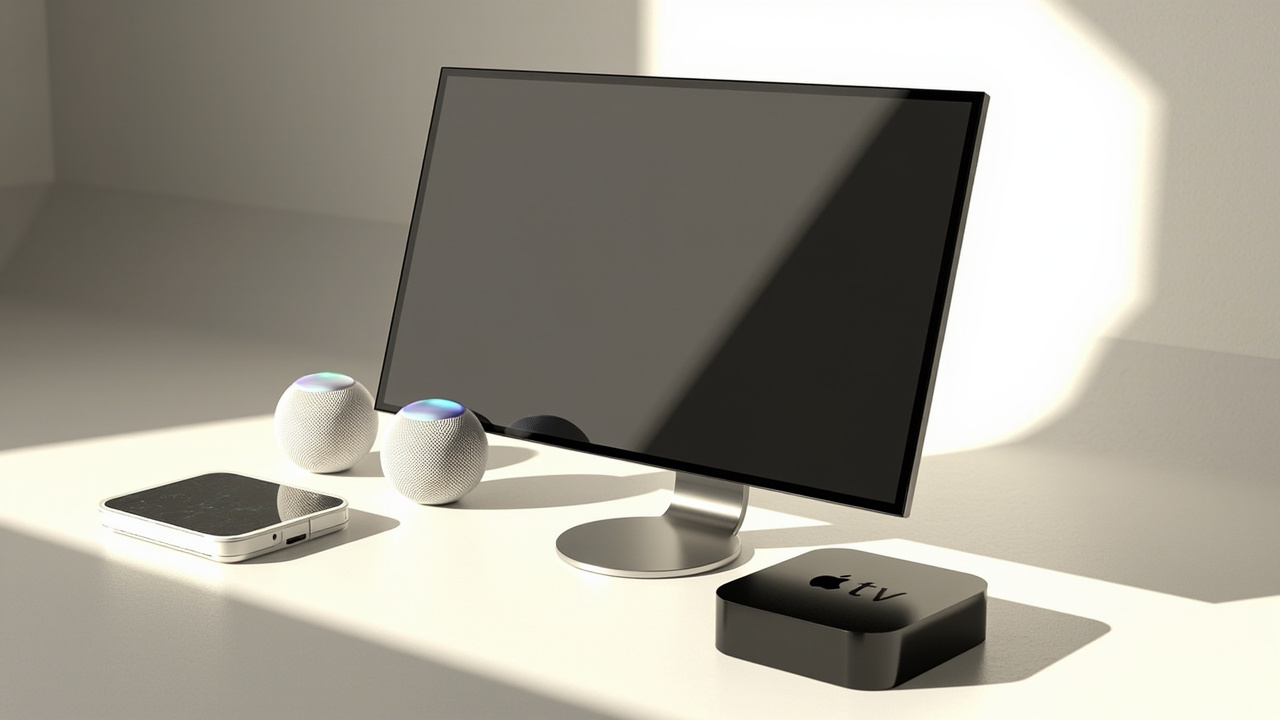
TL;DR: Apple introduced a $299 HomeView smart display, a refreshed HomePod Mini 2 and a new Apple TV 4K on October 13, 2026, headlining an October gadget month documented by The Verge and Apple.
Apple held a Welcome Home event on October 13
Apple unveiled new smart home hardware at an event described as “Welcome Home” on October 13, 2026, according to The Verge.
The lineup centered on HomeView, described by Apple as central to the home and personal to everyone in it.
The announcements also included HomePod mini 2, Apple TV 4K, and accessories developed with LG Electronics and Schneider Electric, according to The Verge.
Pre-orders for HomeView started the day of the announcement, with availability beginning November 13, according to Apple.
Pre-orders for the new Apple TV 4K also started that day, with availability beginning November 13, according to Apple.
Pre-orders for HomePod mini 2 started the same day, with availability beginning Friday, October 30, according to Apple.
HomeView brings a 7-inch display and speaker base
HomeView features a 7-inch Liquid Retina display connected to a domed speaker base by a stainless steel hinge, according to Apple.
The hinge provides smooth tilt for viewing on tabletops of different heights, according to Apple.
HomeView comes in four colors — silver, starlight, rose pink, and space gray — each finished with a matching cable, according to Apple.
The tabletop price is $299, according to The Verge and Apple reporting summarized by Bloomberg and 9to5Mac.
A separate wall-mounted HomeView model is available in space gray and silver, according to Apple.
The wall-mounted version uses the same 7-inch Liquid Retina display and can attach with three purpose-built mounts from Schneider Home, according to Apple.
Mount options include self-installation or professional installation, according to Apple.
Display adjusts from 500 nits to 0.3 nits
HomeView includes adaptive display technologies including True Tone that react to changing light through the day, according to Apple.
Automatic brightness adjusts from 500 nits down to 0.3 nits, according to Apple.
The 500-nit level is described as bright enough to stay vivid in a sunlit room, according to Apple.
The 0.3-nit minimum is described as suitable for nightstand use, according to Apple.
The interface adjusts based on distance, showing simpler information from across the room and richer detail as a person steps closer, according to Apple.
The Verge reported that the display can show smart home control widgets, clock faces, photos, and more.
The Verge also noted a design reminiscent of Apple’s 2002 iMac G4.
Face recognition supports up to six users
HomeView recognizes up to six people and delivers a personalized experience for each one, according to Apple.
Each user receives a personalized Home Screen with apps and widgets, according to Apple.
Personal content stays private from others, while shared photo albums and music can be used by everyone including guests, according to Apple.
A 12-megapixel camera can be used for FaceTime calls, according to The Verge.
The camera enables recognition of up to six different users, automatically shifting from a shared household screen to a personalized hub when perception and recognition features are enabled, according to The Verge.
According to Apple, HomeView recognizes users by their faces, adapting so they can access personal content in Messages, FaceTime, Calendar, Reminders, and Find My.
Siri AI runs through iPhone pairing
HomeView features Siri AI, described as an entirely new version of Siri powered by the next generation of Apple Intelligence and advanced Apple silicon, according to Apple.
Siri AI is described as more capable and conversational with personal context understanding and onscreen awareness, according to Apple.
With broad world knowledge, anyone in the home can ask Siri about virtually any topic, according to Apple.
When paired with an Apple Intelligence-enabled iPhone or iPad, Siri AI can draw on personal context such as Calendar, Messages, and relevant information across apps, according to Apple.
Reported capabilities include managing lighting, thermostat and other smart device controls, and monitoring a live view of up to nine security cameras, according to The Verge.
The Verge reported that Apple Intelligence-powered Siri AI features such as personal context and text descriptions for video feeds are leveraged via an iPhone connection.
The Verge also reported that HomeView requires every user in a household to have an iPhone with the latest OS.
Apple said Siri AI is built with privacy and security at the core.
HomePod Mini 2 adds S10 chip and Sound Glow
The $149 HomePod Mini 2 retains a familiar ball shape, according to The Verge.
Colors are pink, blue, green, white, and midnight, color-matched with current iMac models, according to The Verge.
Apple lists the colors as pink, green, blue, white, and midnight, with pre-orders starting the announcement day and availability October 30.
The device is powered by the same S10 chip found inside Apple Watch Series 10, according to The Verge.
Apple also states HomePod mini 2 is powered by the Apple S10 chip with advanced computational audio.
Connectivity includes WiFi 6E, Bluetooth 6, and both Thread and Matter, according to The Verge.
The top panel retains a lighting swirl upgraded with a “sound glow” feature that matches illumination to album cover art and soundscape designs, according to The Verge.
Apple describes Sound Glow as a visual canvas that glows and pulses in sync with music, reacting in real time to bass and treble.
Apple says album artwork from Now Playing generates a color-matched light experience unique to every song.
Users can select a soundscape like rain to trigger animations for a soothing atmosphere, according to Apple.
Four-speaker home theater arrives with Apple TV 4K
The new Apple TV 4K is priced at $299, according to The Verge.
It is the fourth generation of Apple TV hardware, following a predecessor released in 2022, according to The Verge.
The box includes far-field microphones for hands-free Siri control, according to The Verge.
Apple specifies three far-field microphones with advanced echo cancellation for “Hey Siri” or “Siri” recognition while audio is playing.
Answers are displayed as on-screen text rather than spoken aloud, according to The Verge.
The A19 chip delivers up to 50 percent faster CPU performance and up to 2x faster GPU performance than the previous generation, according to Apple.
The A19 includes a dedicated AV1 decoder for more efficient high-quality streaming while using less bandwidth, according to Apple.
The Siri Remote keeps a familiar design and adds Find My support with Precision Finding and an option to play a sound, according to Apple.
For the first time, users can create a four-speaker surround sound experience with Apple TV 4K (4th generation) and HomePod mini 2, according to Apple.
Four HomePod Mini 2 speakers can be connected together, or two second-gen HomePods with two HomePod Mini 2s, according to The Verge.
The speakers and Apple TV 4K intelligently recognize each speaker’s position in the room so timing and levels calibrate automatically, according to Apple.
The HomePod Mini 2 can automatically calibrate with the new Apple TV 4K to tune audio to the space, according to The Verge.
Apple Home Collection covers lock, doorbell, cameras, thermostats
Six new devices form the Apple Home Collection codeveloped with LG Electronics and Schneider Electric, according to The Verge.
The collection includes a video doorbell, security cameras, door lock, and thermostats examined hands-on by The Verge.
The LG smart lock costs $349 and supports Apple Home Key for hands-free unlocking with UWB, according to The Verge.
The lock also supports PIN-code entry and a physical keyhole beneath the keypad, according to The Verge.
The LG video doorbell costs $249 and includes two cameras supporting up to 2.5K resolution, according to The Verge.
The doorbell cameras record visitors and show package deliveries at the doorstep, according to The Verge.
The doorbell includes a motion-activated light, according to The Verge.
A plug-in indoor camera costs $199 and records video in up to 2.5K resolution, according to The Verge.
The indoor camera moves up and down automatically and can be set to face downward when a user returns home, according to The Verge.
Apple is releasing two wired outdoor camera versions: a $399 model with motion-activated floodlights and a $299 model without lights, according to The Verge.
The round LG smart thermostat and a square model from Schneider Electric cost $199 and support Matter, according to The Verge.
Each device can be controlled with HomeView or other Apple products like an iPhone, according to The Verge.
Oppo set October 21 for Find X10 global launch
Oppo’s Find X10 phones launch outside China on October 21st, according to The Verge.
That date is almost exactly a month after the China launch, according to The Verge.
Highlights include the first triple 200-megapixel camera on the Find X10 Pro Max, according to The Verge.
Both models carry 8,000mAh batteries, though Oppo warns selected markets receive 7,150mAh instead, according to The Verge.
Garmin claimed 320 hours for $899.99 Enduro 4
Garmin’s $899.99 Enduro 4 can track activities for up to 320 hours or function as a basic smartwatch for up to 90 days, according to The Verge.
The sapphire-protected touchscreen has an integrated solar panel, so extending battery life requires daily sun exposure, according to The Verge.
The Enduro does not use a bright OLED display like the Apple Watch Ultra 4, according to The Verge.
The Apple Watch Ultra 4 can run for up to 84 hours between charges, according to The Verge.
Camera gadgets added Xenon flash and film-style body
The $85 Godox A2 integrates a xenon flash tube into a magnetic iPhone accessory, according to The Verge.
The LEDs on the back of a phone cannot compete with bright flashes built into many cameras, according to The Verge.
The rechargeable battery is rated for about 400 photos, according to The Verge.
The A2 can be used remotely up to almost 50 feet away for flash placement experiments, according to The Verge.
Use requires Godox’s own iOS camera app to trigger the flash when pressing the shutter button, according to The Verge.
The Yashica Y16 Pocket Camera was announced as a modern version of a retro film camera first introduced in 1959, according to The Verge.
Upgrades include a 12-megapixel sensor, an LCD display on the back, and a Xenon flash, according to The Verge.
Preorders are available through Yashica’s online store for $114.43 with shipping expected to start in November, according to The Verge.
Flight controller, laptops and handheld updates rounded out October
Reservations are open for Honeycomb Aeronautical’s $179.99 Echo Aviation Controller XPC without a deposit, according to The Verge.
The product was announced last June, with sales starting November 20th, according to The Verge.
The gamepad replaces a standard layout with flight-sim controls including throttle levers, a trim wheel, rudder paddles, and dedicated switches for landing gear and parking brake, according to The Verge.
HP briefly posted a $2,999.99 price for its OmniBook X with an 18-core CPU and 32GB of RAM, according to The Verge, citing Notebookcheck.
An OmniBook 16 was priced at $4,999.99 with 64GB of memory before HP removed both listings, according to The Verge.
Microsoft held a Windows and Surface event the same morning at 10AM PT / 1PM ET, according to The Verge.
Playdate emailed users to update handhelds with older Playdate OS versions to version 3.0.5 or later ahead of its third season of games, according to The Verge.
The secure certificate in older OS versions expires October 15th, blocking access to Playdate servers and requiring a more complicated manual update afterward, according to The Verge.
The Verge also reported that Ansub Khan documented a method using Claude Code or Codex to clean up an old Android TV.
The method includes step-by-step instructions for an owner’s own TV, with a caution to proceed carefully with AI tools, according to The Verge.
Sources referenced
- Everything Apple launched at its Welcome Home event | The Verge (https://www.theverge.com/tech/1009816/apple-smart-home-event-homeview-homepod-mini-roundup)
- Hands-on with the Apple Home Collection | The Verge (https://www.theverge.com/tech/1009899/apple-home-collection-hands-on)