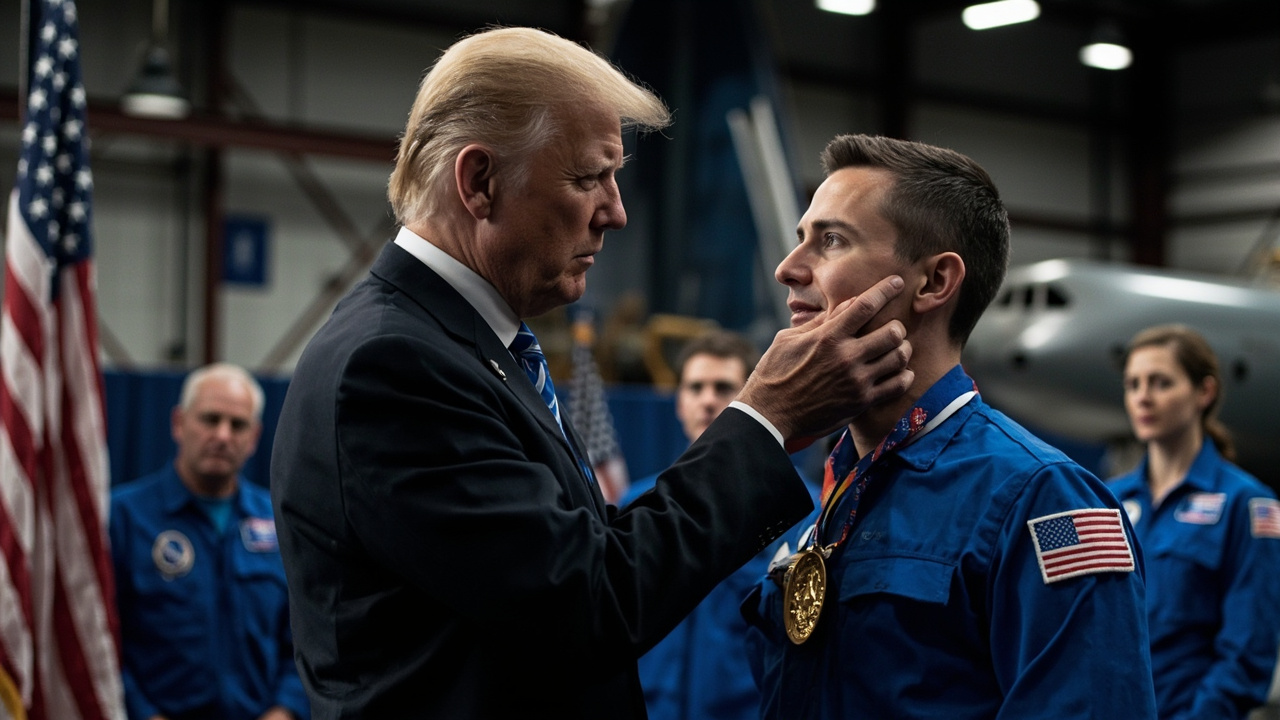
TL;DR: Four Artemis II astronauts received the Congressional Space Medal of Honor on Aug. 28, 2026, at NASA's Johnson Space Center in Houston for a record-setting April 1 to April 10 flight around the Moon aboard Orion.
President Donald J. Trump presented the Congressional Space Medal of Honor to the four members of the Artemis II crew on Friday, Aug. 28, 2026, during a ceremony at NASA's Johnson Space Center in Houston, according to NASA's news release titled "President Honors NASA's Artemis II Crew with Highest US Space Award." The recipients were NASA astronauts Reid Wiseman, Victor Glover and Christina Koch and Canadian Space Agency astronaut Jeremy Hansen. The White House listed the event as a medal presentation to the Artemis II astronauts on Aug. 28, 2026. NASA described the decoration as the highest U.S. space award.
The ceremony recognized service during the Artemis II mission, the first crewed mission under NASA's Artemis program. NASA said the crew members honored Aug. 28 were the first medal recipients since 2023. NASA said there now are 34 recipients of the award since the beginning of the space program. Before the Aug. 28 ceremony, 30 people had received the award, according to Space.com reporting titled "President Trump gives Artemis II moon astronauts the Congressional Space Medal of Honor."
Medal presented in Houston
The presentation took place at NASA's Johnson Space Center in Houston. President Donald J. Trump awarded the medals and presented the awards during the ceremony at the center, according to NASA. NASA+ had scheduled the Congressional Space Medal of Honor ceremony for 11 a.m. EDT on Friday, Aug. 28, at the Johnson Space Center.
During the ceremony, the president personally placed the medal around the necks of each astronaut as they were recognized for work during the mission. Trump described the honor as rare and linked it to courageous and brilliant service. In remarks reported by NASA, Trump said the nation was awarding the Congressional Space Medal of Honor to the crew of Artemis II and saluted engineers, scientists, and launch and landing specialists who helped make the mission a success.
NASA Administrator Jared Isaacman joined the event. Isaacman said the Artemis II crew answered a call with skill and courage and showed the Moon again, according to NASA. Isaacman credited the NASA workforce with industry and international partners for the achievement. Isaacman also thanked the crew for showing the Moon again and for passing knowledge to astronauts who will follow.
Apollo 17 astronaut and former Sen. Harrison Schmitt opened related program remarks by discussing the 1972 mission, the last mission of the Apollo program. NASA Deputy Administrator Matt Anderson said early in the year the Artemis II crew added their names to that history and demonstrated that America is ready to return.
Who the four honorees are
Wiseman served as commander of the mission. Glover served as pilot of the Orion spacecraft. Koch served as a mission specialist. Hansen, a Canadian Space Agency astronaut, also served as a mission specialist.
Wiseman said flying around the Moon with Victor, Christina and Jeremy aboard a spacecraft the crew named Integrity was the honor of his lifetime. Glover said piloting Orion for the first time in space was a profound honor made possible by years of work by countless individuals. Koch said the response to the mission on Earth was beyond anything the crew imagined and said the crew accepted the award to honor people from factory floors to clean rooms and mission control rooms.
Hansen said it was a privilege to receive the Congressional Space Medal of Honor alongside his Artemis II crewmates. Hansen said he shared the recognition with teams in Canada, the United States and international partners. Hansen said Artemis II showed what can be accomplished for humanity when ambitious goals are pursued together and described the Artemis program as a pursuit of excellence and collaboration.
A nine-day flight in April
NASA's Artemis II mission launched on April 1 and splashed down safely in the Pacific Ocean on April 10, according to NASA. Space.com reported that Artemis II launched on April 1 and came back to Earth nine days later. The flight was the first crewed mission of NASA's Artemis program, which aims to establish a long-term base near the Moon's south pole in the coming years, according to Space.com.
The flight sent Wiseman, Glover, Koch and Hansen on a looping journey around the lunar far side. The mission included a lunar flyby. It was the first crewed trip beyond low Earth orbit since Apollo 17 in 1972, according to Space.com. NASA described Artemis II as the first crewed mission under the Artemis program and said it paved the way for later test flights and a return to the lunar surface.
The crew were the first astronauts to launch on the agency's SLS rocket, flying aboard NASA's Orion spacecraft, which the crew named Integrity, according to NASA. Glover served as pilot of Orion. Wiseman commanded the mission aboard Integrity around the Moon with Victor, Christina and Jeremy.
Record distance from Earth
During the mission, the astronauts traveled 252,756 miles from Earth, farther than any humans have traveled before, according to NASA. NASA said the distance surpassed a previous record set by Apollo 13 astronauts in 1970. In total, they flew 695,081 miles, including a lunar flyby, according to NASA.
Space.com reported that the Artemis II astronauts got farther from Earth than any people ever had before. The mission traveled around the lunar far side. NASA called the mission record-setting.
The crew observed a total solar eclipse from beyond the Moon, something human eyes had never seen firsthand before, according to Space.com. Space.com attributed the viewing opportunity in part to orbital dynamics. NASA said the crew showed the world the Moon again.
Spacecraft named Integrity
The Orion spacecraft used for Artemis II was named Integrity by the crew, according to NASA. Wiseman referred to flying on Integrity around the Moon. The crew were the first astronauts to launch on the Space Launch System rocket and fly aboard Orion, according to NASA.
Orion carried the commander, pilot and two mission specialists on the lunar flyby. Glover piloted Orion for the first time in space. Koch served as a mission specialist aboard the spacecraft. Hansen served as a mission specialist aboard the spacecraft.
The mission launched on April 1 and splashed down in the Pacific Ocean on April 10. The nine-day duration covered the 695,081-mile journey reported by NASA. NASA said the safe Pacific splashdown completed the historic flight.
Why the medal is rare
The Congressional Space Medal of Honor was authorized by Congress in 1969 to recognize an astronaut who in performance of duties distinguished himself or herself by exceptionally brave and meritorious efforts and contributions to the welfare of the nation and humanity, according to NASA. Space.com cited Congress' stated criteria as awarding the medal to any astronaut who in performance of duties distinguished himself by exceptionally meritorious efforts and contributions to the welfare of the nation and mankind.
Though the president gives out the medal, he does so on the recommendation of the NASA administrator, according to Space.com. Isaacman was NASA administrator at the Aug. 28 ceremony. NASA identified Isaacman as NASA administrator in its account of the event.
Trump said the medal is bestowed on astronauts who distinguished themselves with exceptional service to the nation and humanity. Trump called the recognition rare. NASA said the Artemis II crew were the first recipients since 2023.
Past recipients and international precedent
There now are 34 recipients of the award since the beginning of the space program, including the crews of Apollo 1, Challenger and Columbia who received the award posthumously, according to NASA. The award was given to each of the 14 astronauts who died in the space shuttle Challenger and Columbia disasters, according to Space.com.
Past honorees include Apollo 11 astronaut Neil Armstrong, according to Space.com. Past honorees include Alan Shepard and John Glenn, who were the first Americans to reach space and orbit Earth, respectively, according to Space.com. Past honorees include Gemini astronaut Ed White, the first American to perform a spacewalk, according to Space.com. Past honorees include Apollo 13 commander Jim Lovell, according to Space.com.
Hansen was not the first non-American to receive the medal. Ilan Ramon, one of seven people who perished when Columbia broke apart upon reentry on Feb. 1, 2003, was from Israel, according to Space.com. Hansen is a Canadian Space Agency astronaut. Hansen shared his recognition with teams in Canada, the United States and international partners.
Flight jacket and in-flight call
The astronauts gave the president a blue flight jacket commemorating the mission, according to Space.com. Glover presented Trump with an official NASA blue flight jacket during the ceremony. Wiseman thanked Trump for calling the crew during their mission.
Wiseman said the call conveyed pride in the work the crew had accomplished. Wiseman said inspiring the nation and the world was what the crew set out to do. Trump recalled watching the Artemis II mission and described viewers as spellbound.
Trump said the United States is entering a golden age of spaceflight and exploration. Trump thanked the Artemis II astronauts for being a guiding light. In remarks cited by Space.com, Trump said the crew's work brought long-discussed spaceflight dreams closer and described the astronauts as leading the way with bravery.
What Artemis II proves for engineers
The first crewed mission under NASA's Artemis program paved the way for the 2027 Artemis III test flight in low Earth orbit to demonstrate rendezvous and docking capabilities between Orion and commercial human landing systems, according to NASA. It also paved the way for the Artemis IV mission in 2028, which will return American astronauts to the lunar surface, according to NASA.
Anderson said the Artemis II crew carried humanity around the Moon for the first time in more than 50 years. Anderson said the flight demonstrated that America is ready to return and paved the way for those who will follow. Isaacman said NASA will build on the success as it returns to the lunar surface and establishes an enduring presence on the Moon.
NASA said it will send Artemis astronauts on missions to explore more of the Moon and establish a Moon Base on the lunar surface for long-term exploration. NASA said those missions will set the stage for sending American astronauts to Mars. Space.com reported that Artemis aims to establish a long-term base near the Moon's south pole.
Wiseman said he looked forward to seeing friends continue the legacy on Artemis III. Hansen said the Artemis program is about more than returning to the Moon. Koch said the crew was grateful to people who followed the journey.
Ceremony record and program context
NASA published its account of the Houston ceremony on Aug. 28, 2026, as Release 26-070. The release identified Jessica Taveau as author and listed Johnson Space Center as the dateline. NASA listed Bethany Stevens, Cheryl Warner, Brandi Dean and Chelsey Ballarte as headquarters and Johnson Space Center contacts.
The White House posted video pages for the Aug. 28 presentation to the Artemis II astronauts. NASA+ listed the ceremony for 11 a.m. EDT on Aug. 28. The Space.com account was last updated Aug. 28, 2026, with quotes and information from the medal ceremony.
Trump saluted engineers, scientists, and launch and landing specialists in Houston. Glover said the crew shared the recognition with thousands of people who launched the spacecraft around the Moon and brought it safely back to Earth. Koch cited factory floors, clean rooms and mission control rooms among contributors honored through the award.
The mission record of 252,756 miles from Earth exceeded the 1970 Apollo 13 mark. The total mission distance was 695,081 miles. The spacecraft was Orion, named Integrity. The launch vehicle was the Space Launch System.
The medal count now stands at 34 recipients. The authorization year was 1969. The latest presentation year was 2026. The prior recipients before 2026 included 30 people, followed by the four Artemis II crew members honored in Houston.
Sources referenced
- President Honors NASA’s Artemis II Crew with Highest US Space Award - NASA (https://www.nasa.gov/news-release/president-honors-nasas-artemis-ii-crew-with-highest-us-space-award/)
- President Trump gives Artemis II moon astronauts the Congressional Space Medal of Honor | Space (https://www.space.com/space-exploration/artemis/trump-gives-artemis-ii-moon-astronauts-congressional-space-medal-of-honor)