TL;DR: Margaret Hamilton, who led MIT's onboard flight software work for NASA's Apollo program, died on Sept. 30 in Cambridge, Massachusetts, at age 90, as announced Oct. 7-8 by MIT and family.
Death announced by MIT and family
Margaret Hamilton died on Sept. 30 at a hospital in Cambridge, Massachusetts, according to MIT News, which published its obituary on Oct. 7, 2026. She was 90, according to MIT News, NPR and BBC reporting published on Oct. 7 and Oct. 8.
Her daughter, Lauren Hamilton, told The Associated Press that her mother died Sept. 30 at a hospital in Cambridge, Massachusetts, according to ABC News reporting of the Associated Press account on Oct. 8, 2026. NPR reported that Hamilton's death of unspecified causes was announced Wednesday by the Massachusetts Institute of Technology.
Hamilton worked at MIT from 1959 until the mid-1970s, according to MIT News and NPR. BBC reported that she managed the Software Engineering Division at MIT.
NASA Administrator Jared Isaacman said on the social platform X that her work helped make humanity's first journeys to the moon possible, according to ABC News. Olivier de Weck, the Apollo Program Professor and interim head of the MIT Department of Aeronautics and Astronautics, said in a statement carried by MIT News:
"To say Margaret Hamilton was a pioneer — to say she was ahead of her time — would be a dramatic understatement."
De Weck said Hamilton was a software engineer at a time when that field was in its infancy, and that she developed advanced code and led a team using that nascent technology to develop one of the most complex systems humanity had ever achieved, according to MIT News. NPR carried the same assessment from de Weck, in which he said she not only developed advanced code herself but also led a team in using that nascent technology to develop one of the most complex systems humanity had ever achieved.
De Weck added that the Apollo program stands as testimony to collaboration, ingenuity and engineering and that Hamilton was a fundamental contributor to its success, according to MIT News. He also said that for Hamilton Apollo was just the beginning, that she went on to become an entrepreneur and remained on the cutting edge of systems software, while acting as advocate, mentor and inspiration to millions, according to MIT News.
Indiana childhood and mathematics education
Hamilton was born in Paoli, Indiana, in 1936, according to MIT News and BBC. NPR reported that she grew up in Indiana.
She began studying mathematics at the University of Michigan in 1955 before transferring to Earlham College, where she earned a BA in mathematics with a minor in philosophy in 1958, according to MIT News. NPR reported that she earned a BA in mathematics with a minor in philosophy from Earlham College in 1958. BBC reported that she first studied mathematics at the University of Michigan in 1955 before moving to Earlham College where she received a BA in mathematics in 1958.
She moved to Boston, Massachusetts, in 1959 with her husband while he pursued a law degree, according to MIT News. NPR reported that she moved to Boston the following year so her husband could pursue his law degree. BBC reported that she moved to Boston, Massachusetts, a year later with her husband and originally took the job at MIT to support her husband during his law degree. ABC News reported that she graduated with a degree in mathematics from Earlham College in Richmond, Indiana, in 1958 and went to work for MIT in 1959.
Earlham College said in a statement on social media, as reported by the BBC:
"We are saddened by her death, but grateful for the opportunity to have celebrated her extraordinary achievements throughout her long life"
The college added that her pioneering spirit and remarkable legacy will continue to inspire generations of Earlhamites, according to the BBC.
Weather software and first programming work
Hamilton soon found a temporary position in the meteorology department at MIT, working with professor of meteorology Edward N. Lorenz on weather prediction software, according to MIT News. ABC News reported that her early focus at MIT included working with a meteorology professor on weather prediction software, citing the MIT News article.
This was her first entry point into computer programming, according to MIT News. NPR described it as her first foray into software engineering, reporting that she took a job in the meteorology department at MIT working with the professor who discovered chaos theory.
Her work would go on to inform Lorenz's future publications on chaos theory, according to MIT News. Lorenz held the degrees SM '43, ScD '48, according to MIT News.
SAGE air-defense work and focus on reliability
From there, Hamilton took a role as a programmer at MIT Lincoln Laboratory in 1961, working on the Semi-Automatic Ground Environment (SAGE) project, the United States' first air defense system, according to MIT News. NPR reported that she then obtained a programming job in another lab, working on the SAGE project, the United States' first air defense system.
Hamilton wrote software for the prototype AN/FSQ-7 computer (XD-1), used by the U.S. Air Force to search for potentially unfriendly aircraft, according to MIT News. During this time, Hamilton began to take an interest in software reliability — a new and largely unexplored concept at the time, according to MIT News.
Teasel Muir-Harmony, curator of the Apollo Collection at the Smithsonian National Air and Space Museum, told NPR:
"She had so much foresight in thinking through the ways that humans would use computers, and to create reliable systems that could be used even in the highest-risk, life and death kind of environments"
NPR reported that Hamilton was known for her focus on "defensive" programming, building software that could anticipate and solve errors on its own. Muir-Harmony told NPR that Hamilton's goal was not simply to build a system that worked when everything went right, but to build a system that could continue working when things went wrong.
Hired as first Apollo programmer at MIT
In 1965 Hamilton was preparing to pursue graduate studies when her husband saw an advertisement in the newspaper: The Instrumentation Lab at MIT was seeking people to develop software to "send man to the moon," according to MIT News. The lab had won the contract from NASA to build the onboard flight software for the Apollo program, according to MIT News.
Intrigued by the challenge, Hamilton applied, and was hired as the first programmer for the Apollo project at MIT, as well as the first female programmer in the project, according to MIT News. NPR reported that in 1961 MIT's Instrumentation Lab won the NASA contract to develop software for the Apollo project, that Hamilton saw a newspaper advertisement seeking people to develop the software to "send man to the moon," and that she was the first female programmer hired for the Apollo missions, starting with uncrewed flights and moving to onboard software.
ABC News reported that in the mid-1960s she started at MIT's Instrumentation Lab, which had a NASA contract for Apollo. BBC quoted Hamilton's 2019 recollection to the Guardian about joining:
"I was attracted both by the sheer idea and the fact that it had never been done before. I was the first programmer to join and the first woman they hired"
Hamilton worked first on the software for the uncrewed missions, according to MIT News and NPR. ABC News reported that after first working on software for uncrewed missions, she later led the team developing the onboard flight software for the crewed missions.
MIT News reported that over two decades at MIT, Hamilton forged new paths in computer science and engineering, and that her groundbreaking work included leading the team that programmed the first computers that took humans to the moon. ABC News described her as a groundbreaking computer scientist who led the team that created the onboard flight software for NASA's moon-bound Apollo program.
Leading more than 100 engineers and coining a discipline
By 1968, she had worked her way up to assistant director in charge of the Command and Service Module team, leading a crew of over 100 engineers, according to NPR. MIT News reported that a 1969 photo showed listings of the software developed by the Lunar Module and Command and Service Module on-board flight software teams at MIT, that Hamilton led both teams, and more than 400 people, working on Apollo's software.
NPR reported that Hamilton was in her early 30s, as were many of her colleagues in the nascent field of software engineering — a term she herself is credited with coining. BBC reported that she led the team who developed the software for NASA's Apollo missions, which coined the term "software engineering."
MIT News reported that Hamilton authored over 130 publications and helped to establish software engineering as a dedicated discipline. NPR reported that Hamilton, like many people who worked on the Apollo program, helped develop computing as known today, citing Muir-Harmony. Muir-Harmony told NPR that in this period where Hamilton was working, this was a brand new field, and that she really helped to define it.
Hamilton often brought her daughter, Lauren, then 4, to the lab — resulting in an infamous "Lauren error," according to NPR. Dean Robbins, a children's book author who published Margaret and the Moon: How Margaret Hamilton Saved the First Lunar Landing, in 2017, told NPR that her daughter overloaded a system during some kind of test, and that Hamilton thought this was something that could actually happen in outer space and that she should account for it. NPR reported that Robbins said her daughter actually played a part in her technical achievements.
Apollo 11 alarms and priority-driven software
Perhaps the most famous example of defensive design came during the Apollo 11 mission in 1969, according to NPR. Just three minutes before the first humans were supposed to touch down on the moon, alarms went off on board, signifying computer overload, according to NPR. BBC reported that in 1969, moments before the historic Apollo 11 Moon landing, an onboard computer raised an alarm, signalling an error was occurring, and that the error detected the computer was overloaded.
Hamilton and her team had planned for such an error by engineering "priority-driven software" to shut down background tasks and favour the most important task — the moon landing — according to the BBC, citing MIT. NPR reported that Hamilton's team had built a system that could shut down unnecessary background tasks at that moment.
Mission Control was able to recognize what was happening and to trust the computer to prioritize tasks and to know that the astronauts could continue with the first lunar landing, according to NPR, citing Muir-Harmony. BBC reported that she led a team of engineers writing and testing all onboard in-flight software for NASA's Apollo 11 project that guided U.S. astronauts Neil Armstrong and Buzz Aldrin to land safely on the moon.
An Associated Press file photo from Nov. 25, 1969, shows Hamilton of Cambridge, Massachusetts, mathematician and computer programmer at the MIT Instrumentation Laboratory, sitting in a mockup of the Apollo command module on display at MIT, where she headed the group that programmed Intrepid's pinpoint landing in the Sea of Storms on the moon, according to ABC News. NPR described the same era with a 1969 file image of Hamilton sitting in a mock-up of the Apollo command module on display at MIT.
Entrepreneur, medal recipient and public symbol
After leaving MIT, Hamilton founded two software engineering companies, according to NPR. BBC reported that from the 1970s onwards, Hamilton used her expertise to found her own software businesses, including Hamilton Technologies, which is still based in Massachusetts. MIT News reported that she worked at MIT from 1959 until the mid-1970s, after which she became a successful computing entrepreneur and CEO.
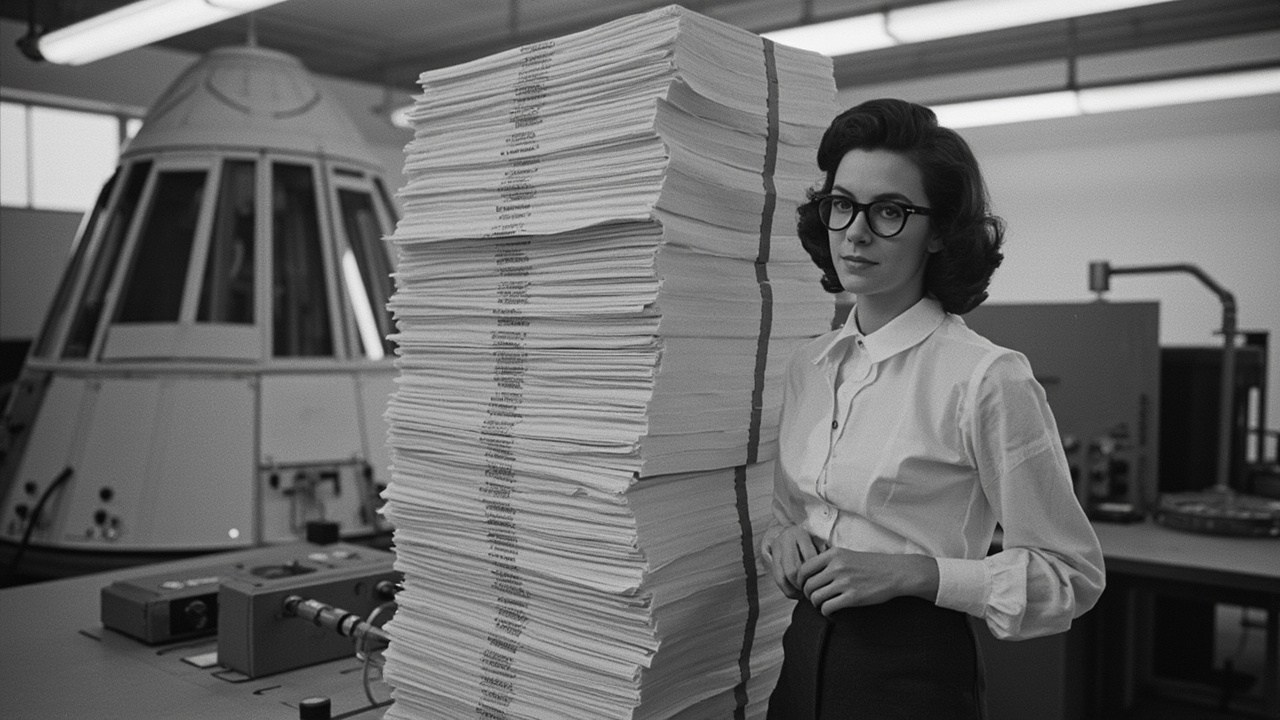
In recent years, a photo circulated online showing a smiling Hamilton, in her early 30s, standing next to a towering stack of pages containing codes her team used during the Apollo project, according to ABC News. MIT News described a now-famous photo of Hamilton standing beside listings of the software developed by the Lunar Module and Command and Service Module teams taken at MIT in 1969. NPR reported that Hamilton is the subject of a black-and-white photo from 1969 that often circulates on social media, showing a young woman with long hair and glasses, smiling as she stands beside a towering stack of notebooks filled with the code that sent humans to the moon. The BBC reported that the team's software work was immortalised in a 1969 photograph of Hamilton standing beside the stack of printed code that towered beside her.
Her life's work was recognized with many awards and honors, including the 2016 Presidential Medal of Freedom from President Barack Obama, according to MIT News. The award citation noted, according to MIT News:
"Hamilton defined new forms of software engineering and helped launch an industry that would forever change human history."
The citation added that her software architecture led to giant leaps for humankind, writing the code that helped America set foot on the moon, according to MIT News. BBC reported that in 2016 Hamilton's work was honoured by Barack Obama with the Presidential Medal of Freedom for her contribution to science and space travel. The medal was presented during a ceremony in the East Room of the White House on Nov. 22, 2016, according to MIT News. NPR reported that she received the Presidential Medal of Freedom from Barack Obama in 2016. Obama said Hamilton "symbolises that generation of unsung women who helped send humankind into space," according to the BBC.
A Lego set celebrating the women of NASA that was unveiled in 2017 included a figure of Hamilton, according to ABC News. MIT News reported that in 2017 Lego released its Women of NASA set, which included likenesses of four women in NASA history, including Hamilton. NPR reported that the following year she was immortalized in miniature as part of a "women of NASA" Lego set. The set's original designer was Maia Weinstock, deputy editorial director of MIT News, and Lego designer Tara Wike '97 viewed the near-final prototype with Hamilton, according to MIT News.
ABC News reported that the marking in 2019 of the 50th anniversary of the Apollo 11 moon landing also brought attention, citing her daughter. Lauren Hamilton told the Associated Press, according to ABC News:
"She definitely went from nobody knowing who she was to suddenly everyone knowing who she was, especially in her field"
Lauren Hamilton added that her mother was really happy to be acknowledged for what she did, but was a reserved person so the spotlight was not necessarily a natural thing for her, according to ABC News.
Robbins said Hamilton was "not one to toot her own horn," according to NPR. NPR reported that she initially shied away from the idea of a biography and only agreed because she thought it would be fun to read with her great-grandchildren. Robbins recalled that she warmed to explaining what she had done, developing the software, became excited about telling technical aspects, and sent photos and code she had written and pictures of the machinery used in the 1960s, according to NPR.
Hamilton is survived by her daughter, a son-in-law, two grandsons and four great-grandchildren, according to MIT as reported by the BBC. NPR reported that she is survived by four great-grandchildren, two grandsons, her daughter and son-in-law and three siblings.
Sources referenced
- MIT News - Margaret Hamilton, computing pioneer who led software development for the Apollo program, dies at 90 (https://news.mit.edu/2026/margaret-hamilton-computing-pioneer-dies-1007)
- ABC News (Associated Press) - Margaret Hamilton, who led a software team for NASA's Apollo program, dies at 90 (https://abcnews.com/Technology/wireStory/margaret-hamilton-led-software-team-nasas-apollo-program-137110168)