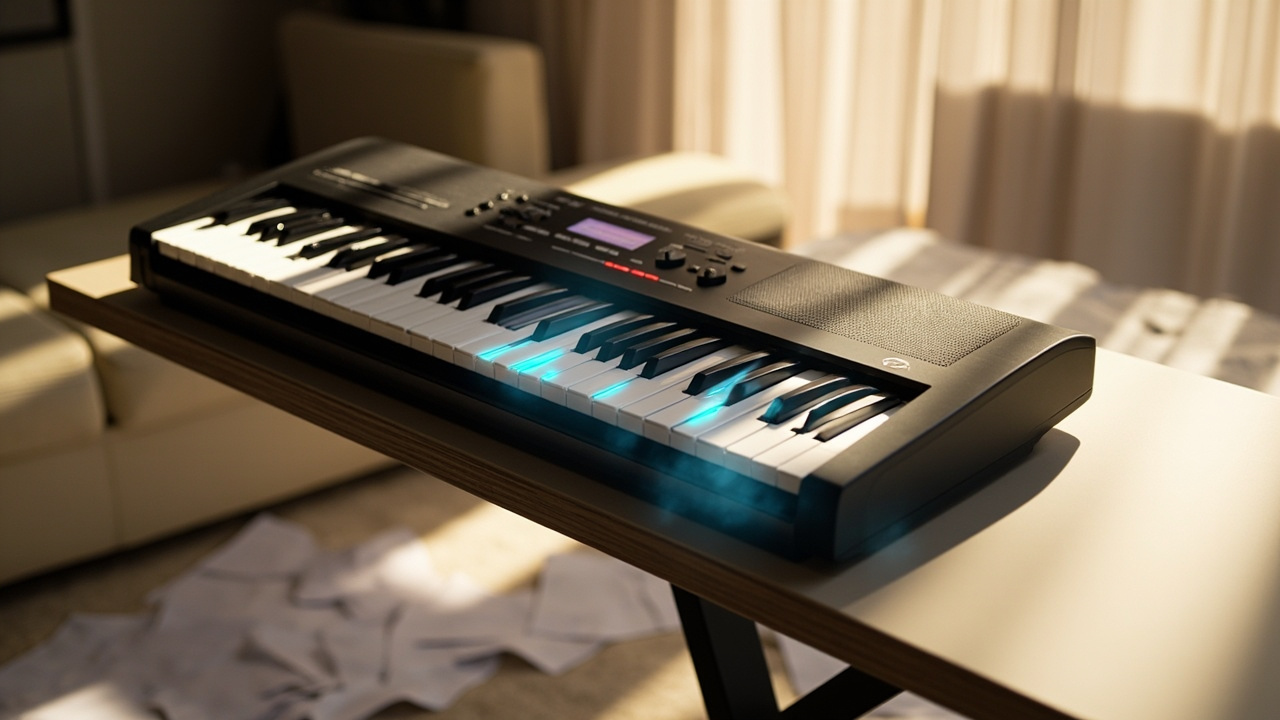
Casio launched the CT-FS1 keyboard on November 3, 2026, with a feature called Feel Sync that makes it physically impossible to play a note that clashes with whatever song is loaded into its companion app — a first for a consumer keyboard at this price point.
The instrument retails for $399.99 and ships in two colorways: Midnight Black and Alpine White. It is available immediately through authorized music retailers and Casio's music gear website, according to The Verge.
What Feel Sync Actually Does
Feel Sync is the name Casio gives to the real-time note-filtering system built into the CT-FS1. The process starts in a companion mobile app, available on both iOS and Android. A player uploads any song in MP3 or WAV format, and the app's algorithm analyzes that audio file. Once analysis is complete and the song is playing back through the keyboard, the system constrains the instrument so that only harmonically appropriate notes can sound — no matter which keys the player physically presses.
The practical result is that someone who has never touched a keyboard before can sit down, load a favorite track, and improvise freely over it without producing a discordant sound. The player still controls rhythm and timing entirely; Feel Sync handles only pitch selection, steering every keypress toward a note that fits the song's harmonic content in that moment.
Brian Piccolo, Senior General Manager at Casio America, Inc., described the intent plainly: "Feel Sync lets people experience that feeling immediately with songs they love," according to reporting by Engadget.
Hardware Specs and Design
The CT-FS1 carries 61 touch-responsive keys, meaning the instrument responds to both the speed and pressure of each keypress and translates that input into dynamic variation in note volume. That touch sensitivity distinguishes it from entry-level keyboards that produce a flat, uniform tone regardless of how the keys are struck.
Built-in stereo speakers deliver a surround-sound effect intended to make solo practice sessions more immersive. Bluetooth connectivity ties the keyboard wirelessly to the Feel Sync app and to other compatible devices, eliminating the need for a cable between the instrument and a smartphone or tablet during a play-along session.
Portability was a deliberate design priority. The CT-FS1 weighs under ten pounds and can run on AA batteries as well as a standard AC adapter, making it practical for use away from a fixed home setup — a music lesson, a friend's house, or an outdoor gathering.
A dual-zone capability divides the keyboard into two independent sections. In practice, this lets a beginner use Feel Sync on one half of the keyboard while an experienced player performs conventionally on the other half, so the two can play together from the same instrument without the note-filtering interfering with the skilled musician's side.
Standard Keyboard Mode Still Available
Feel Sync is a mode, not a permanent constraint. The CT-FS1 operates as a fully conventional keyboard when the app-guided mode is switched off, giving players the freedom to practice scales, chord voicings, and standard repertoire without any filtering applied. That flexibility matters because it means the instrument can grow with a student: a complete beginner can build confidence and rhythm awareness through Feel Sync sessions, then toggle it off to confront the full complexity of unassisted playing as their skills develop.
Casio has positioned this transition as a core part of the product's value proposition. The keyboard is not marketed as a permanent shortcut but as a confidence-building on-ramp that removes the initial discouragement many new players feel when their first attempts sound chaotic.
Why This Engineering Approach Is Notable
Real-time harmonic filtering of a keyboard's output is a non-trivial engineering problem. The app must analyze a commercial audio recording — which may contain multiple instruments, production effects, and varying tempo — and extract harmonic information accurately enough to constrain a keyboard's output on a note-by-note basis with no perceptible latency. Casio's implementation accepts both MP3 and WAV uploads, meaning the system must handle compressed as well as lossless audio, two formats with meaningfully different spectral characteristics.
The Bluetooth link between phone and keyboard also introduces a latency variable that could disrupt the feel of real-time play if not managed carefully. Consumer Bluetooth audio connections have historically introduced delays of 100 milliseconds or more, which is perceptible as a timing gap. That the system is designed for simultaneous app playback and filtered keyboard output suggests Casio's engineering team treated latency minimization as a primary constraint, though the company has not published specific latency figures.
Competitive Context
The beginner keyboard segment has seen a wave of feature differentiation in recent years. Roland introduced the GO:KEYS 3, a youth-oriented keyboard that integrates colorful design cues and playful sounds to appeal to younger first-time players. That product targets a different aesthetic and age demographic than the CT-FS1, which carries a more adult-focused monochromatic aesthetic and a heavier emphasis on algorithmic song integration.
At $399.99, the CT-FS1 sits above the sub-$150 entry tier but below professional instruments. Casio has manufactured electronic musical instruments since the late 1970s, giving the company decades of supply-chain and tuning experience that informs the acoustic quality of even its consumer-grade products, according to The Verge's coverage of the launch.
Who the CT-FS1 Is Designed For
Casio's stated audience is adults and older teens who want to engage with music but feel blocked by the technical barrier of avoiding wrong notes during early practice. The product targets people who know what songs they enjoy and want to interact with that music actively rather than passively, without the months of foundational study that conventional keyboard instruction requires before a beginner can play recognizably through a song.
The dual-zone feature also makes the keyboard useful in social contexts — a household where skill levels vary, a classroom setting, or a casual gathering where someone with training wants to demonstrate something alongside a person who has never played. By splitting the keyboard into independent zones, the device supports collaboration rather than demanding uniform skill from every person at the instrument.
Engadget's coverage of the launch noted that the keyboard's under-ten-pound weight and battery option reinforce its design as an instrument meant to leave the living room, not remain anchored to a desk or dedicated music studio.
Availability and Pricing
The CT-FS1 is priced at $399.99 and went on sale immediately following Casio's November 3, 2026 announcement. It is available through authorized music retailers and directly through Casio's music gear website in both Midnight Black and Alpine White. The companion Feel Sync app is a free download on iOS and Android, and Casio has not announced any subscription fee associated with its use.