TL;DR: NASA launched the $4 billion Nancy Grace Roman Space Telescope on Aug. 30, 2026, aboard a SpaceX Falcon Heavy to map dark energy, dark matter and exoplanets from a million miles away.
Liftoff opens a new flagship era
NASA started its next flagship astrophysics mission on Sunday, Aug. 30, 2026, with the successful launch of the Nancy Grace Roman Space Telescope from Florida, according to Reuters.
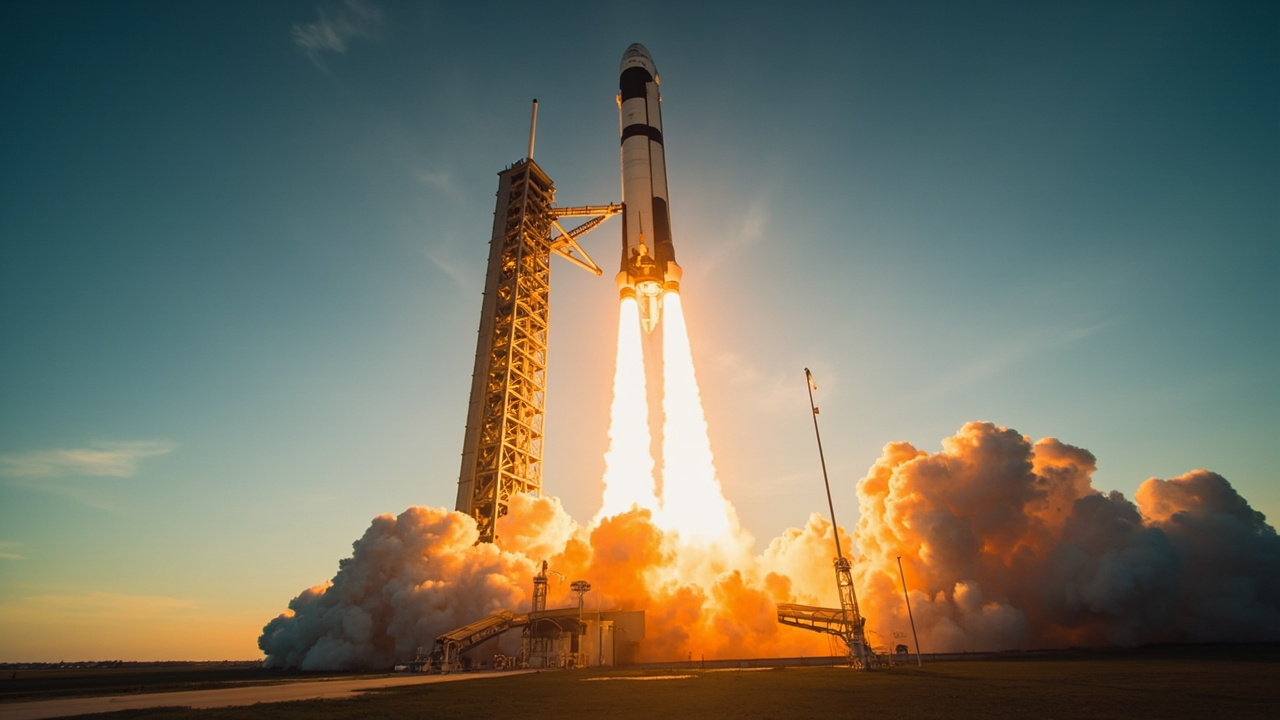
The observatory lifted off at 7:26 a.m. EDT from Launch Complex 39A at NASA's Kennedy Space Center in Cape Canaveral aboard a SpaceX Falcon Heavy rocket, according to NASA. The heavy-lift vehicle climbed through blue skies just after sunrise, beginning a long cruise to a gravitationally stable observing post beyond the Moon.
The flight marked the start of a planned five-year primary mission, although NASA said the spacecraft may carry enough propellant for five additional years of operations, according to Reuters. That extended lifetime would allow a decade of wide-area infrared surveys, exoplanet searches and cosmological mapping if instruments and funding remain healthy.
NASA Administrator Jared Isaacman described Roman as a mission delivered ahead of schedule and on budget after more than a decade of work by agency teams and industry partners, according to NASA. In remarks reported by Reuters, Isaacman also said he had no doubt Roman would become widely recognized alongside Hubble and Webb as an instrument of discovery.
Senior project scientist Julie McEnery framed the moment as a handoff from builders to researchers, telling reporters it represented an endpoint for engineers and a starting point for scientists, according to Reuters. Project manager Jackie Townsend said the team expected to receive its first high-resolution images before the winter holidays, while NASA said in its launch announcement that it anticipates releasing Roman's first images by early 2027.
During the post-launch news conference, Isaacman took a call from President Donald Trump and held the phone to his microphone, according to Reuters. Trump said the launch looked beautiful on television and told the NASA team it was doing a fantastic job, in comments linked to NASA's approximately $24 billion 2026 budget.
How launch morning unfolded
The Falcon Heavy performed as expected during the critical first half-hour, according to NASA.
Ground controllers at NASA's Goddard Space Flight Center in Greenbelt, Maryland, began receiving telemetry from Roman seven minutes after liftoff. Spacecraft separation from the rocket occurred 31 minutes into flight. After separating from the center core, the two side boosters returned to the launch site for refurbishment, according to NASA.
About one hour and 23 minutes after launch, the team confirmed successful deployment of the observatory's solar panels and lower instrument sun shade. Those deployments provided electrical power and began establishing the thermal protection needed for sensitive infrared observations.
The mission is the fourth primary NASA mission to fly on a Falcon Heavy, according to NASA. The agency's Launch Services Program worked with SpaceX to move the launch date earlier to accommodate the telescope's early completion. NASA said the launch came nine months ahead of schedule, a detail also reflected in reporting carried by CBC News.
Communications during departure relied first on NASA's Near Space Network ground stations and relay satellites for tracking, telemetry and commands. About 70 minutes after launch, the Deep Space Network took over guidance toward the destination, according to NASA. Roman first connected through the Canberra Deep Space Communication Complex in Australia, with handoffs planned about six hours later to Madrid in Spain and then to Goldstone in California to maintain continuous contact during the outbound journey.
In the days after separation, controllers planned to deploy the high-gain antenna and visor-like deployable aperture cover, execute the first of two mid-course corrections and power on the Coronagraph Instrument, according to NASA. A few weeks into the voyage, the primary Wide Field Instrument was scheduled for activation, followed by months of calibration.
The million-mile trip to Lagrange Point 2
Roman is now on a roughly three-month, million-mile journey to its final orbit, according to NASA.
Its destination is the second Sun-Earth Lagrange point, known as L2, about one million miles — about 1.6 million kilometers — from Earth, according to NASA and Reuters. That location, beyond the Moon as seen from Earth, offers a stable thermal and gravitational environment with an unobstructed view of deep space.
Mission scientists will spend the next 90 days commissioning the observatory and preparing for science operations, according to Reuters. Commissioning includes checking spacecraft systems, aligning optics, cooling and characterizing detectors, calibrating pointing and verifying communications at full data rates.
Throughout the three-month commissioning period, scientists will run the instruments through calibrations and tests before routine surveys begin, according to NASA. Once at L2, Roman will maintain a halo-like path that keeps Earth and the Sun largely behind it, helping keep the telescope cold and stable for infrared work.
The cruise itself is also an engineering test. The observatory must remain in contact through the Deep Space Network, perform trajectory adjustments and sequentially deploy sensitive hardware without contamination or mechanical problems. NASA said the rigid design and stable optical performance are intended to let Roman scan rapidly without long settling times between separate observations.
If commissioning proceeds as planned, routine science could begin after the 90-day checkout, with early demonstration images offering a first check of image sharpness, background levels and survey speed.
Two instruments built for speed and contrast
Roman pairs a very wide field of view with crisp infrared vision to cover large areas of sky while still probing deeply into cosmic history, according to NASA.
Its primary instrument, the Wide Field Instrument, is a 300-megapixel infrared camera containing 18 detectors, each capable of 4K resolution and roughly the size of a saltine cracker, according to NASA. The detectors collect photons that are decoded into sharp cosmic panoramas. NASA said the telescope is designed to survey the universe a thousand times faster than Hubble.
That speed does not mean lower quality in the usual sense. McEnery has said Roman has broadly the same sensitivity and sharpness as Hubble but can survey much more quickly, according to Reuters. As one comparison, she said Roman could survey the entire Milky Way galaxy in a month, work that would require about a century with Hubble.
The second instrument is a coronagraph designed to block starlight and reveal faint planets nearby. It will demonstrate technology that future missions such as NASA's Habitable Worlds Observatory concept could use to image Earth-like planets while searching for life, according to NASA. On Roman, the coronagraph will take a major step in that direction by photographing Jupiter-like worlds.
Roman will transmit 1.4 terabytes of data to Earth every day, the highest data rate for any NASA astrophysics mission to date, according to NASA. Machine learning, artificial intelligence and volunteers will help sift through the flow and flag significant findings for professional astronomers to study. Julie McEnery, Roman's senior project scientist at NASA Goddard, said researchers had never viewed the universe with eyes like Roman's before.
Management is centered at NASA Goddard, with participation by the Jet Propulsion Laboratory in Southern California, Caltech/IPAC in Pasadena, California, the Space Telescope Science Institute in Baltimore and scientists at research institutions, according to NASA. Primary industrial partners are BAE Systems Inc., L3Harris Technologies and Teledyne Scientific & Imaging, with contributions from ESA, JAXA, the French space agency CNES and the Max Planck Institute for Astronomy in Germany.
Hunting dark matter, dark energy and distant worlds
Roman's core task is to explore dark matter, dark energy and exoplanets, while supporting a broad range of additional astronomy, according to NASA.
The telescope will investigate dark energy and dark matter, test gravity at vast scales and search for planets beyond the solar system, according to Reuters. Dark energy is hypothesized to drive the accelerating expansion of the universe. Dark matter is known through its gravitational influence on galaxies and stars but has not been directly observed.
The universe began with the Big Bang about 13.8 billion years ago and has expanded ever since, according to reporting carried by CBC News. Ordinary matter — stars, planets, gas, dust and familiar materials on Earth — may account for about 5% of the contents of the universe. Dark matter may account for about 27%, while dark energy may account for about 68%.
Roman will help clarify the push of dark energy and the pull of dark matter by creating the most comprehensive three-dimensional map of the universe to date, according to CBC News. Its main survey, expected to take more than a year, will cover more than two billion galaxies. By measuring how galaxies are distributed and how their light is distorted by intervening mass, astronomers can trace cosmic structure across time.
The observatory will build on the James Webb Space Telescope, launched in 2021, and the Hubble Space Telescope, launched in 1990, according to Reuters. Webb has shown that early galaxies formed sooner and grew larger than previously known, using deep, highly sensitive observations to look across vast distances. NASA describes Roman as a wide-angle lens and Webb as a zoom lens, in an analogy noted by CBC News. Webb finds rare objects in the early universe in great detail, while Roman supplies the broad view that places those discoveries in context.
Exoplanet science is the other pillar. In addition to coronagraph images of giant planets, Roman is expected to use gravitational microlensing — brief brightenings when a foreground star and planet bend the light of a background star — to find colder and more distant worlds that other methods miss. Those surveys, combined with the massive data archive, are intended to support studies ranging from galaxy evolution to stellar populations and transient phenomena.
Nicky Fox, associate administrator for NASA's Science Mission Directorate, said Roman would act as a discovery machine that brings researchers closer to answers about cosmic history, according to NASA. She said its large field and rapid survey pace would open a new era of discovery, make the invisible visible and help lay groundwork for the search for life beyond the solar system.
From unused spy hardware to star surveyor
One of the most unusual parts of Roman's story is its hardware heritage.
The observatory was originally designed for a spy-satellite effort under the National Reconnaissance Office, the intelligence-community organization that operates powerful U.S. reconnaissance spacecraft, according to Reuters. That program ran over budget and was terminated. In 2012, the NRO donated hardware to NASA, which reworked it for astrophysics.
The gift gave NASA a telescope structure with a mirror comparable in size to Hubble's but arranged to provide a much broader field. Political support grew as NASA reshaped the former reconnaissance asset into a civilian cosmology and planet-hunting mission, rather than starting mirror fabrication from scratch.
The spacecraft honors Nancy Grace Roman, NASA's first chief astronomer, often called the mother of the Hubble Space Telescope, according to CBC News. Roman championed space astronomy and helped make Hubble possible, making the name a bridge between Hubble's legacy and the new survey mission.
Budget history was turbulent. The Trump administration sought during both its first and second terms to cancel Roman or reduce its funding, but Congress preserved the program, according to Reuters. The administration had also proposed cutting NASA funding by about $6 billion, while the agency's approximately $24 billion 2026 budget ultimately survived, according to Reuters. Against that backdrop, NASA emphasized disciplined execution and an accelerated schedule.
Roman's planners say the combination of inherited optics, new infrared detectors, rapid surveying and open data should make it a lasting resource. Beyond dark energy and exoplanets, its surveys will support research far outside the main science goals, according to NASA. With 1.4 terabytes arriving daily, archival discoveries may continue long after the planned five-year mission ends, especially if fuel allows up to five more years.
For now, attention turns to deployment milestones, trajectory corrections and instrument checkout on the way to L2. If those steps succeed, astronomers expect panoramic infrared maps of unprecedented scale — a new atlas of the universe built, remarkably, on hardware once intended to look down at Earth and now pointed outward at the cosmos.
Sources referenced
- NASA launches powerful Roman Space Telescope, a spy satellite turned to the stars | Reuters (https://www.reuters.com/science/nasa-launches-powerful-new-roman-space-telescope-florida-2026-08-30/)
- NASA’s Dark Universe-Seeking Nancy Grace Roman Space Telescope Launches - NASA (https://www.nasa.gov/news-release/nasas-dark-universe-seeking-nancy-grace-roman-space-telescope-launches/)